
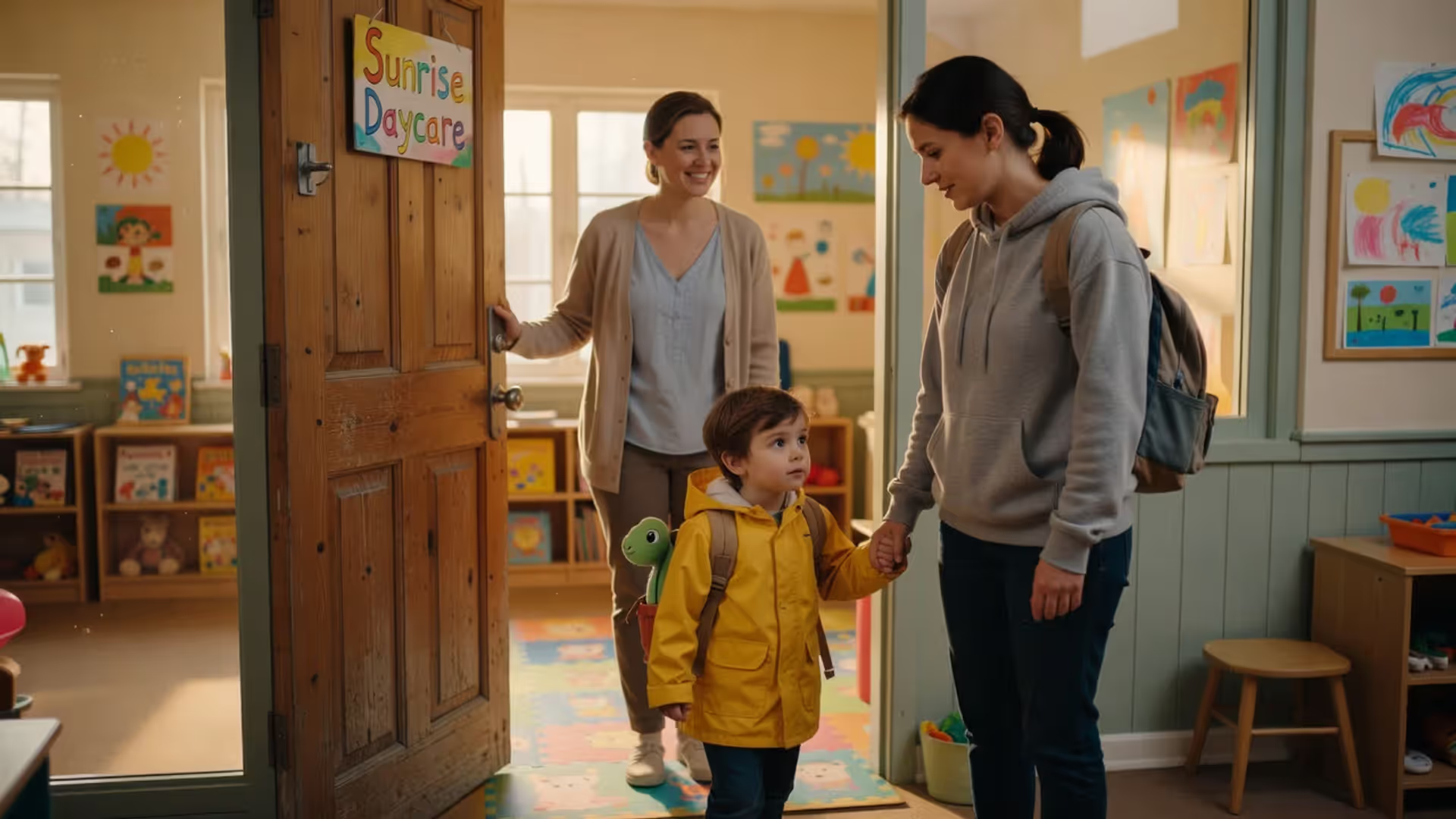
Questions for Daycares Every Parent Should Ask Before Enrolling
Questions for Daycares Every Parent Should Ask Before Enrolling

Few parenting decisions carry as much daily weight as handing your child over to someone else's care for eight or nine hours a day. The facility might look welcoming on the surface — bright murals, organized cubbies, a friendly receptionist — but appearances rarely reveal what actually happens once you leave. Asking the right questions for daycares before you commit to anything is the most practical tool you have. It separates places that perform well during tours from ones that consistently deliver quality care.
Why Asking the Right Questions Matters Before You Choose
Most parents arrive at a daycare tour hoping for a strong gut feeling. That instinct has value — but it has limits. A warm atmosphere won't tell you whether the center passed its last safety inspection, how staff handle a child who is inconsolable at drop-off, or what the protocol is when a two-year-old runs a fever at 11 a.m.
The pattern worth avoiding: spending most of your visit on surface-level details — the snack menu, the nap schedule, the art projects on the wall — while skipping the questions that actually determine whether a facility is safe and well-managed.
When working through choosing a daycare questions, sequence matters. Start with compliance and safety. Move to daily operations. Finish with costs and logistics. That order keeps you from emotionally investing in a space before you've confirmed it meets your non-negotiables.
What to Ask About Safety, Licensing, and Staff Credentials
This is the foundation. Everything else builds on it.
A licensed facility has cleared minimum state requirements for health, safety, and supervision. But that threshold exists to define the lowest acceptable standard — not to identify excellent care. Some centers exceed those requirements by a significant margin. Others scrape by. Your job during this part of the visit is to figure out which category you're looking at.
Staff-to-Child Ratios and Caregiver Turnover
Ask directly: how many children is each caregiver responsible for in the room my child would be placed in? For babies under one year, a 1:3 or 1:4 ratio reflects what child development research supports as genuinely safe. For one- and two-year-olds, somewhere around 1:4 or 1:5 is reasonable. When you see numbers climbing above 1:6 for the youngest age groups, that warrants a direct follow-up about how coverage works during breaks and transitions.
According to Child Care Aware of America, recommended staff-to-child ratios vary by state, but parents should always compare what a center offers against national best-practice standards — not just local legal minimums.
Caregiver turnover is the question that gets skipped most often. A center where staff rotate out every few months signals something worth understanding — whether that's low pay, poor management, or a difficult work environment. Any of those factors affects your child directly. Ask how long the current lead teachers in the infant or toddler room have been employed there. A confident, stable program will answer that without hesitation.
Background Checks and Licensing Requirements
Every adult with unsupervised access to children should have completed a criminal background check — including substitutes and part-time aides. Ask whether that requirement applies universally or only to full-time employees.
Ask when the facility was last inspected by the state and whether you can review that report. In most states, inspection records are part of the public record. A well-run center will hand you that document without any prompting. One that hedges, changes the subject, or tells you it's not available is giving you useful information — just not the kind you were hoping for.

Author: Garrett Willowmere;
Source: colorfulpagescoalition.org
Questions to Ask During a Daycare Tour
The tour is where the gap between a center's marketing and its actual operation becomes visible. Arrive with your questions written down. Relying on memory during a 45-minute walk-through — while a director is talking and children are moving around you — is how important things get missed.
Strong daycare tour questions cover both the practical and the cultural. How does staff handle a child who refuses to transition from outdoor play? What does a typical Tuesday morning look like for an 18-month-old? Can parents stop by during the day without scheduling it in advance? A center that operates with integrity will say yes to that last one without hesitation.
What to Watch For Beyond the Answers You Receive
The verbal answers matter. What's happening in the background matters just as much.
Are children engaged in what they're doing, or are they mostly waiting for something to happen? Is the space organized in a way that suggests intentional use, or does it feel like things are just stored there? When a caregiver speaks to a child, do they crouch down to eye level, or do they address the room from a standing position while looking elsewhere?
A tour that takes you through active classrooms mid-session tells you far more than one scheduled during a rest period or after most children have gone home. If your visit happens to fall during a quiet window, ask whether you can return on a different morning when the program is in full swing. A center that resists that request is worth noting.
One practical observation: many parents spend the majority of their tour evaluating the physical environment — the playground equipment, the book selection, the art supplies. Those details have value. But the room itself is not what shapes your child's experience. The people working in it are.

Author: Garrett Willowmere;
Source: colorfulpagescoalition.org
Daily Routines, Curriculum, and Communication Policies
Once the safety and compliance questions are answered, it makes sense to explore what the day-to-day experience actually looks like. These questions for daycares help you evaluate whether the program's structure aligns with your child's developmental stage and your family's expectations.
Ask for a breakdown of the daily schedule. How much time is structured versus child-directed? For toddlers, a program built entirely around formal instruction is developmentally mismatched — but so is one with no intentional learning built in at all. Ask whether the curriculum follows a recognized framework. Programs referencing approaches like Creative Curriculum or HighScope have typically made a deliberate investment in how learning is structured. Programs that describe their approach as "we just follow the children's interests" without any further explanation may be doing meaningful work — or they may not have a coherent plan at all.
Communication with parents deserves its own set of questions. Ask specifically how the center keeps families informed throughout the day. Some programs send real-time updates through dedicated apps; others provide a written summary at pickup. Neither format is inherently superior, but you should know what to expect before day one. More importantly, ask what the process is when something goes wrong — a fall, a conflict between children, a behavioral pattern that's been developing. Who reaches out? Within what timeframe? Through what channel?
The illness policy is easy to overlook and important to nail down. Ask what specific symptoms require a child to stay home and how long they must be symptom-free before returning. If the answer is vague or shifts depending on who you ask, that inconsistency tends to show up in practice too — and it affects your work schedule as much as your child's health.
Costs, Contracts, and Enrollment Policies
This is the section where many parents go quiet because financial questions feel uncomfortable to raise during what has otherwise been a warm conversation. Push through that discomfort.
Full-time care at a licensed center in the United States can range from around $1,000 to over $2,500 per month depending on your region, the age of your child, and the type of program. Infant rooms consistently cost more than preschool classrooms because the required caregiver ratios are more demanding. Ask for a written breakdown of every fee — not just the base tuition, but registration costs, supply fees, charges for late pickup, and any activity-based add-ons.
Ask how tuition adjustments are handled year to year. A center that has never raised rates in five years is unusual; what you're really trying to understand is whether increases are predictable and communicated in advance, or whether families find out about them on short notice.
Go through the enrollment contract carefully before putting anything in writing. Ask about the withdrawal notice period — how far in advance you must notify the center before removing your child, and whether tuition continues during that window. Ask about deposit and hold policies: what you pay to secure a spot, whether it applies to your first month's tuition, and what happens to it if your circumstances change before the start date.
A question that rarely gets asked but matters: what happens if the center itself has to close — due to a significant weather event, a licensing suspension, or a public health situation? Knowing the answer in advance removes a layer of stress from a scenario that, while uncommon, does happen.

Author: Garrett Willowmere;
Source: colorfulpagescoalition.org
Daycare Visit Checklist to Use on the Day
Bring this with you. Work through it as you go rather than trying to reconstruct the visit afterward.
Before you arrive:
- Schedule your tour during active program hours, not rest time
- Write out your top questions in advance — at minimum ten
- Record the facility's license number so you can verify it independently
During the tour:
- Note how staff acknowledge children and incoming parents
- Check that exterior doors are secured and not propped open
- Look for posted emergency evacuation procedures
- Ask to see the most recent state inspection report
- Confirm the caregiver-to-child ratio in the specific room your child would use
- Request the illness and symptom policy in writing
- Observe whether children appear settled and purposefully engaged
- Ask directly whether parents may visit during the day without prior notice
After the tour:
- Search your state's childcare licensing database to verify current status
- Review any complaint or violation history on file
- Send a follow-up email with any questions that went unanswered during the visit
Using a daycare visit checklist this way transforms what could be a pleasant but forgettable walk-through into a structured evaluation with a paper trail you can refer back to when comparing multiple facilities.
Red Flags to Watch for When Evaluating a Daycare
Some warning signs are immediate. Others take a second pass to notice.
The obvious ones: caregivers focused on their phones while children play nearby without supervision, rooms that can't be seen into from the hallway, a director who becomes visibly uncomfortable when asked about inspection records, or staff who cannot immediately state the ratio in their own classroom.
The subtler ones are worth equal attention: caregivers who don't address children by name, a director who frames unannounced parent visits as a logistical problem rather than a reasonable expectation, enrollment contracts with termination clauses that heavily favor the center, or a long waitlist that the director seems reluctant to explain or quantify.
Evaluating a daycare is not a search for a flawless facility — those don't exist. It's a process of identifying deal-breakers before they become your daily reality. A center that fields your questions with confidence and specificity is already demonstrating something meaningful about how it operates. One that deflects, generalizes, or makes you feel like you're asking too much is also telling you something.

Author: Garrett Willowmere;
Source: colorfulpagescoalition.org
Key Questions to Ask by Daycare Topic Area
| Topic Area | Questions to Ask | What a Strong Answer Includes |
| Safety and Licensing | Is the facility currently licensed? When was the most recent state inspection? | License number provided on request; inspection report shared without hesitation |
| Staff Qualifications | What training do caregivers hold? Do background checks apply to all staff, including substitutes? | Verified background checks for every adult; lead caregivers hold recognized early childhood credentials |
| Daily Schedule | Walk me through a typical morning for a child my child's age. | Structured sequence with a clear balance of guided activity and child-directed time |
| Communication with Parents | How do you update families during the day? Who contacts me if something happens? | Specific method described; clear process for reporting incidents, not a vague "we'll call you" |
| Costs and Contracts | What does the full fee breakdown look like? What advance notice is required before withdrawal? | Itemized cost sheet provided; withdrawal terms clearly written into the contract |
| Health and Illness Policies | Which symptoms mean my child stays home? How long before they can return after being sick? | Written policy available; criteria consistent with current public health guidance |
Parents should look for programs where caregivers are warm and responsive, where learning happens through play, and where the environment feels safe and predictable. The quality of those daily interactions is what shapes a child's development most.
— Donovan Lisa
Frequently Asked Questions About Choosing a Daycare
The right facility will not just satisfy your checklist — it will be a place where the staff seem genuinely glad to be there, and where children look like they belong. That matters. But warmth without accountability is not enough. Ask your questions, document what you observe, and give yourself permission to keep looking if something doesn't add up. Thorough questions are not a sign of distrust. They're the most direct way to find a place you can actually feel good about every morning.
Related Stories

Read more

Read more




The content on this website is provided for general informational and educational purposes only. It is intended to explain concepts related to parenting, child development, family caregiving, adoption, fostering, and child safety.
All information on this website, including articles, guides, and examples, is presented for general educational purposes. Outcomes may vary depending on individual family circumstances.
This website does not provide professional medical, psychological, or legal advice, and the information presented should not be used as a substitute for consultation with qualified pediatricians, child psychologists, or family counselors.
The website and its authors are not responsible for any errors or omissions, or for any outcomes resulting from decisions made based on the information provided on this website.