

Age Appropriate Behavior in Children by Developmental Stage
Age Appropriate Behavior in Children by Developmental Stage

Every parent has had that moment — your child does something that stops you cold, and you think: Is this normal? Maybe your 2-year-old threw herself on the floor at the grocery store. Maybe your 10-year-old slammed his door so hard the pictures rattled. Maybe your 7-year-old told a lie so convincing you almost believed it. Before you spiral, take a breath. Understanding age appropriate behavior means recognizing that children aren't misbehaving on purpose most of the time — they're just being exactly where they are developmentally.
Why Behavioral Expectations Vary by Age
Children's brains are not finished products. Not even close. The prefrontal cortex — the part responsible for impulse control, planning, and regulating emotions — doesn't fully mature until the mid-20s. So when a 3-year-old can't stop herself from grabbing a toy off the shelf, that's not defiance. That's neuroscience.
Three major factors shape how a child behaves at any given age.
Brain development is the biggest one. Younger children literally lack the neural hardware to control impulses, delay gratification, or manage big emotions consistently. That hardware builds slowly, through experience and maturation.
Temperament plays a real role too. Some kids are naturally more intense, more sensitive, or slower to warm up to new situations. A child who's always been highly reactive will likely show stronger emotional responses at every stage — that's not a parenting failure, it's wiring.
Environment rounds out the picture. A child navigating a new school, a family move, or a new sibling is under stress. Stress always shows up in behavior, especially in kids who don't have the words to explain what they're feeling.
This is why developmentally appropriate practice — the framework used by early childhood educators across the US — centers on meeting children where they are, not where adults wish they were. It's a simple idea with a big payoff: realistic expectations reduce conflict and support healthier development.
One common mistake parents make here is comparing siblings. Two kids from the same household can have wildly different behavioral profiles at the same age. That's normal. Development isn't a straight line.
Normal Child Behavior by Age Group

Author: Rebecca Thornfield;
Source: colorfulpagescoalition.org
Understanding typical behavior at each age helps you stop asking "what's wrong with my kid?" and start asking "what does my kid need right now?" Here's a practical breakdown.
Toddlers Ages 1 to 3
Toddlers are little scientists running experiments on the world — and on you. They're figuring out cause and effect, testing limits, and learning that they're separate people from their caregivers. This is developmentally appropriate behavior, even when it's exhausting.
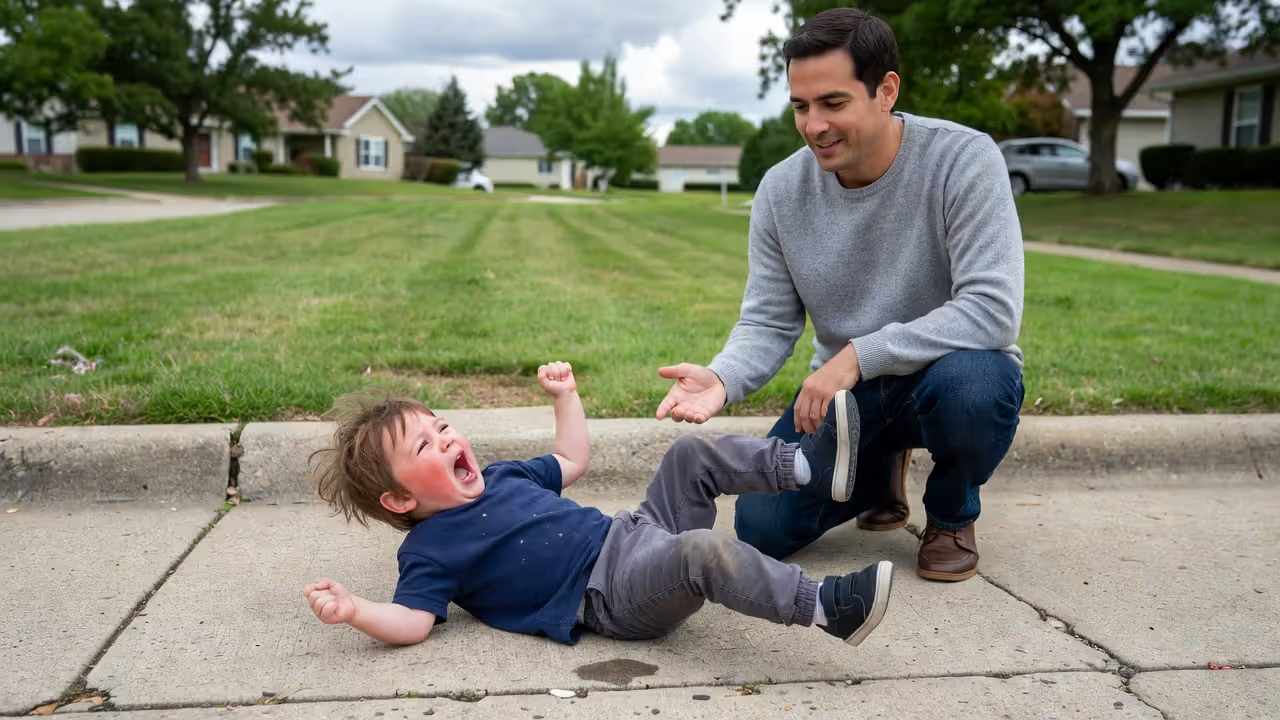
Expect tantrums. Expect "no" as a default answer. Expect biting, hitting, and grabbing — not because your child is aggressive, but because they have almost no language and zero impulse control. A 2-year-old who hits when frustrated isn't a bully. They're a 2-year-old.
Parallel play (playing near but not really with other kids) is completely normal at this stage. Don't push cooperative play too hard before age 3.
Preschoolers Ages 3 to 5
This is the age of magical thinking, big imagination, and some pretty spectacular meltdowns. Preschoolers are starting to understand rules but can't consistently follow them under stress. They'll lie — not maliciously, but because the line between fantasy and reality is genuinely blurry for them.
Four-year-olds in particular are known for pushing limits hard. They're testing their own power and autonomy. Bossy behavior, silly humor taken too far, and defiance at bedtime? All typical.
Sharing is still genuinely hard at this age. A 4-year-old who won't share isn't selfish — their sense of ownership is developmentally intense right now.
Early Elementary Ages 6 to 8
Kids in this range are becoming more logical, more social, and more aware of what other people think of them. Peer relationships start to matter a lot. You'll see more rule-following (they love fairness at this age) but also more social anxiety and worry about fitting in.
Meltdowns don't disappear — they just look different. A 7-year-old might cry over homework or shut down completely when overwhelmed. That's still emotional regulation in progress.
This is also when lying becomes more sophisticated. A 7-year-old who lies to avoid getting in trouble is showing normal cognitive development, not a character flaw.
Tweens Ages 9 to 12
The tween years bring the beginning of puberty for many kids, and with it, a surge in emotional intensity. Mood swings, eye rolls, and a sudden need for privacy are all part of normal child behavior by age in this range.
Tweens are pulling away from parents and toward peers — that's healthy and necessary. But it can feel like rejection. It isn't.
The pattern I see most often is parents taking tween behavior personally. A 10-year-old who says "you don't understand me" isn't attacking you. They're practicing independence.
Age Appropriate Expectations for Kids at Home and School
| Age Group | Expected Behaviors | Common Challenges | Appropriate Caregiver Response |
| Toddlers (1–3) | Parallel play, simple instruction-following, beginning to use words | Tantrums, biting, hitting, separation anxiety | Stay calm, name emotions, offer limited choices |
| Preschoolers (3–5) | Cooperative play, basic turn-taking, following 2-step directions | Defiance, lying, meltdowns, difficulty sharing | Consistent routines, natural consequences, praise effort |
| Early Elementary (6–8) | Following multi-step rules, forming friendships, reading social cues | Peer conflict, homework resistance, emotional outbursts | Problem-solving together, validate feelings, set clear expectations |
| Tweens (9–12) | Managing longer tasks, navigating peer groups, more abstract thinking | Mood swings, risk-taking, pushing back on rules | Stay connected, give autonomy with structure, listen more than lecture |
Behavioral expectations by age look different at home than at school — and that's expected. At school, children are in a structured environment with clear external cues. At home, they're decompressing. Many kids hold it together all day and then fall apart the moment they walk through the front door. That's not bad behavior. That's trust.

Author: Rebecca Thornfield;
Source: colorfulpagescoalition.org
Age appropriate expectations for kids in school settings should account for developmental stage. Expecting a kindergartner to sit still for 45 minutes is unrealistic. Expecting a 10-year-old to manage a group project with minimal adult help is reasonable.
Behaviors That Look Concerning but Are Developmentally Normal
Some behaviors genuinely alarm parents — and understandably so. But many of them fall squarely within normal child behavior by age.
Tantrums past age 3. Yes, they can still happen at 5 or even 6. Frequency and intensity should decrease, but occasional full-blown meltdowns aren't automatically a red flag.
Lying at ages 4–8. Kids this age lie to avoid punishment, to test reality, or to impress peers. It's uncomfortable, but it's normal cognitive development.
Aggression in toddlers. Hitting, biting, and throwing are common before age 3. They typically decrease as language develops.
Defiance in preschoolers. "No" and "you can't make me" are peak 4-year-old. It's frustrating. It's also healthy autonomy development.
Regression under stress. A 6-year-old who starts wetting the bed after a new sibling arrives isn't broken. They're stressed. Regression is a normal response to change at almost any age.
Understanding child behavior means resisting the urge to pathologize normal development. Not every tantrum is a disorder. Not every lie is a character issue.
Author: Rebecca Thornfield;
Source: colorfulpagescoalition.org
When Behavior May Signal a Developmental Concern
There's a difference between typical variation and a pattern that's worth a closer look. Developmentally appropriate behavior exists on a spectrum — and some children sit at the edges of that spectrum in ways that need support.
Talk to your pediatrician if you notice:
- Tantrums that are extremely frequent (multiple times daily past age 4), very long (over 25 minutes), or involve self-harm
- Significant language delays — no words by 12 months, no two-word phrases by 24 months
- Persistent aggression that doesn't decrease after age 3
- Extreme difficulty with transitions or sensory input at any age
- Social withdrawal or loss of skills the child previously had
None of these automatically mean something is wrong. But they're worth discussing. Early support — whether it's speech therapy, occupational therapy, or a behavioral evaluation — almost always leads to better outcomes than waiting.
The key question isn't "is my child bad?" It's "does my child need more support than typical development provides?"
How to Respond to Age Appropriate Behavior Effectively
Author: Rebecca Thornfield;
Source: colorfulpagescoalition.org
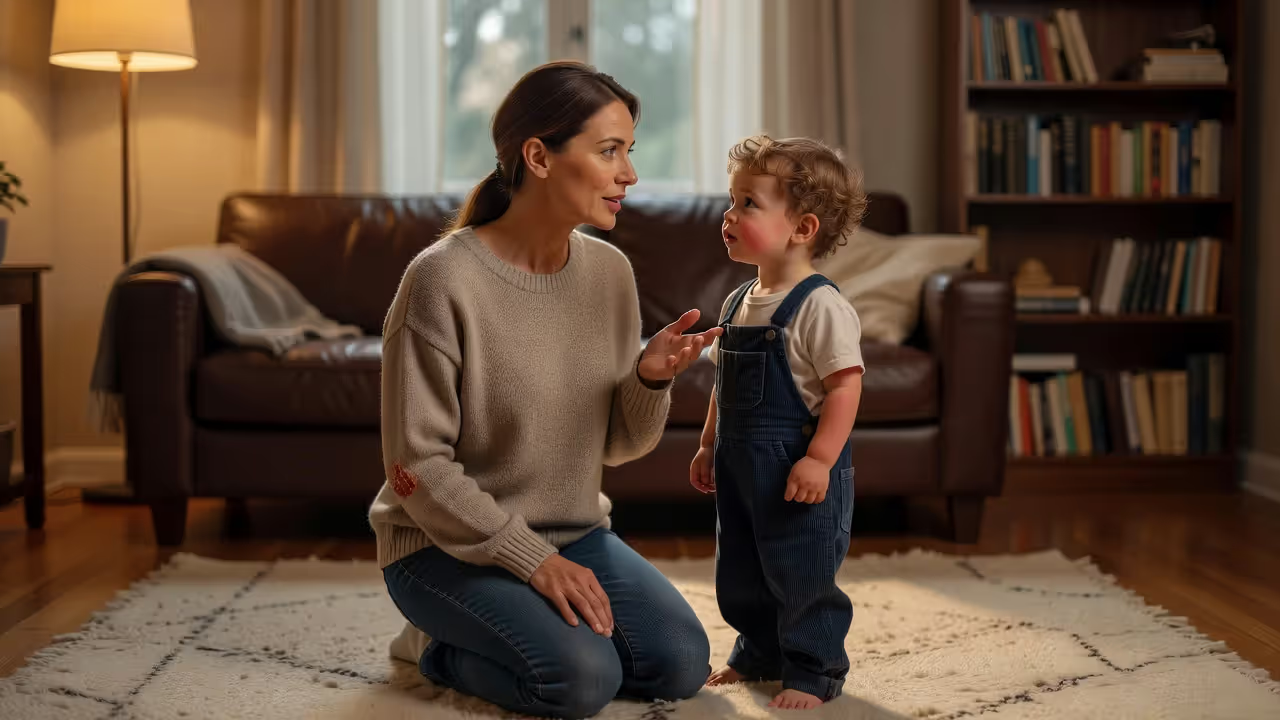
Matching your response to your child's developmental stage makes a real difference. Here's what that looks like in practice.
For toddlers: Keep it simple. One-word redirects work better than long explanations. "Gentle hands" lands better than "we don't hit because it hurts people." Validate the emotion before addressing the behavior. And pick your battles — not everything needs a correction.
For preschoolers: Routines are your best friend. Predictability reduces defiance because kids know what's coming. Natural consequences (you didn't put your shoes on, so we leave late) teach more than lectures. Praise the behavior you want to see more of.
For early elementary: Kids this age can handle more reasoning. Explain the "why" behind rules. Let them participate in problem-solving. A before/after comparison that works well here: instead of "stop arguing and do your homework," try "what would help you get started?" — the second approach gets compliance faster because it respects their growing autonomy.
For tweens: The biggest shift is from directing to consulting. Ask more, tell less. Stay curious about their world. Consequences still matter, but connection matters more — a tween who feels understood is far more likely to follow your lead.
Children are not miniature adults. They are developing human beings whose behavior reflects where they are, not where we want them to be.
— Brazelton T. Berry
That framing changes everything. When you see behavior as information rather than defiance, your responses become more effective — and a lot less exhausting.
FAQ: Child Behavior and Development Questions Answered
Raising kids is one long exercise in recalibrating expectations. The more you understand about what's typical at each stage, the less you'll spend second-guessing yourself — and the more energy you'll have for actually connecting with your child. Behavior is always communication. Your job isn't to stop the behavior. It's to understand what it's saying.
Related Stories

Read more

Read more



The content on this website is provided for general informational and educational purposes only. It is intended to explain concepts related to parenting, child development, family caregiving, adoption, fostering, and child safety.
All information on this website, including articles, guides, and examples, is presented for general educational purposes. Outcomes may vary depending on individual family circumstances.
This website does not provide professional medical, psychological, or legal advice, and the information presented should not be used as a substitute for consultation with qualified pediatricians, child psychologists, or family counselors.
The website and its authors are not responsible for any errors or omissions, or for any outcomes resulting from decisions made based on the information provided on this website.