

Allowance and Chores Guide for Parents
Allowance and Chores Guide for Parents

Setting up an allowance and chores system at home sounds simple until you're actually doing it. Suddenly you're fielding questions like "Do I get paid if I only did half?" or "Why do I have to clean my room for free?" Parents across the US wrestle with these exact moments every week. The good news is that a little structure goes a long way — and you don't need a perfect system, just a consistent one.
Why Linking Chores to Allowance Is a Debated Topic
The question of whether chores should be tied to allowance has split parenting experts for decades. On one side, you have the argument that paying kids for chores teaches real-world money skills — you work, you earn. On the other, child development researchers warn that attaching money to every task can erode a child's natural sense of responsibility. If the payment stops, so does the behavior.
The concern isn't imaginary. Studies on motivation suggest that external rewards can actually undermine intrinsic motivation over time. A child who once made their bed because it felt good to have a tidy room may stop doing it the moment the dollar incentive disappears.
But here's the counterpoint: most adults don't clean bathrooms because they love it. They do it because it's their job. Teaching kids that effort has value isn't a bad lesson — it's a realistic one.
The tension isn't really about money. It's about what you want your child to internalize: "I contribute to this household because I'm part of it" versus "I contribute when there's something in it for me." Both outcomes are possible depending on how you set things up.
How to Decide If Chores Should Be Tied to Allowance
Before you pick a model, ask yourself three questions. What's your primary goal — financial education, household teamwork, or both? How old is your child? And how consistent can you realistically be with tracking and paying out?
Your answers will point you toward one of three common approaches.
Pay-for-Chores Model
In this model, kids earn money specifically for completing assigned tasks. Finish the dishes — earn $1. Skip them — earn nothing. It's straightforward and mirrors how employment works.
This works well for older kids, around 10 and up, who can connect effort to reward over a week-long cycle. The downside is that it can create a transactional mindset. Some parents report their kids started refusing tasks that weren't on the "paid list," which is exactly the wrong lesson.
Fixed Allowance Model
Here, kids receive a set weekly amount regardless of chores. Chores are treated as a baseline family expectation, not a service rendered. The allowance exists purely to teach money management.
This model is cleaner in some ways. It separates two different lessons — responsibility and financial literacy — and lets you teach both without them getting tangled. The risk is that it removes a natural motivator for kids who need one.
Hybrid Approach
The hybrid is what most families actually end up using, even if they don't name it that. Kids have a set of non-negotiable household chores (making their bed, clearing their plate, picking up toys) that they do without pay. Then there's a second tier of optional or extra tasks — washing the car, raking leaves, cleaning out the garage — that earn bonus money.
The simpler option usually wins here. If your system requires a spreadsheet to manage, it won't last three weeks. Keep the non-negotiables short and the bonus tasks genuinely optional.
Age Appropriate Chores by Developmental Stage
Matching tasks to developmental ability is where a lot of parents go wrong. Expecting a 5-year-old to scrub a toilet sets everyone up for frustration. Giving a 14-year-old nothing but "put your shoes away" is a missed opportunity.
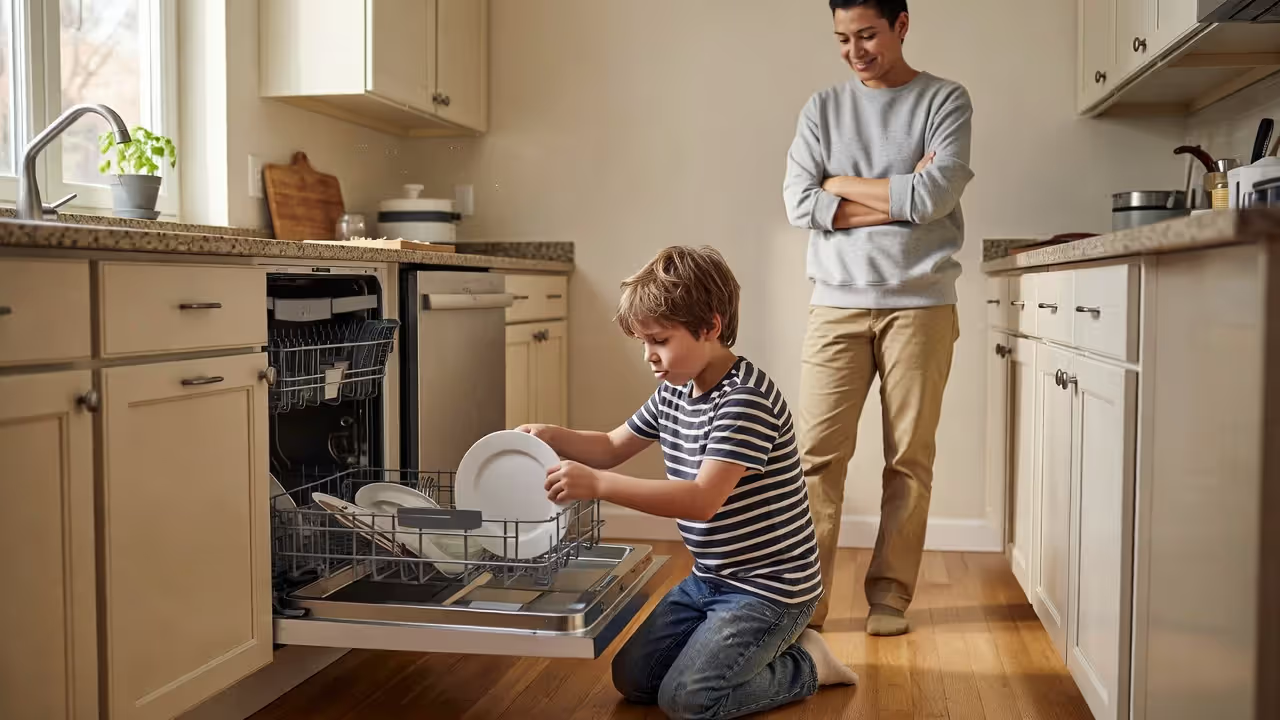
Child development stages matter here because physical coordination, attention span, and abstract thinking all evolve at different rates. A 7-year-old can load a dishwasher with supervision. A 10-year-old can run a load of laundry start to finish.
Author: Madeline Ashcroft;
Source: colorfulpagescoalition.org
Here's a practical breakdown by age group, along with suggested allowance ranges and how much oversight you should expect to provide:
| Age Range | Example Chores | Suggested Weekly Allowance | Level of Supervision Needed |
| 3–5 years | Pick up toys, put dirty clothes in hamper, wipe spills with help | $0–$1 | Constant, side-by-side |
| 6–8 years | Make bed, set/clear table, feed pets, water plants | $2–$4 | Frequent check-ins |
| 9–11 years | Load/unload dishwasher, vacuum, fold laundry, take out trash | $5–$8 | Occasional reminders |
| 12–14 years | Cook simple meals, mow lawn, clean bathroom, grocery list help | $8–$15 | Minimal, task-based |
| 15–17 years | Do own laundry, meal prep, deep cleaning, yard work | $15–$25+ | Independent, with accountability |
Allowance amounts vary widely by region, family income, and what the allowance is meant to cover. These ranges reflect common US benchmarks as of 2026 but aren't rules — they're starting points.
Chore Ideas for Kids That Actually Get Done
The biggest predictor of whether a chore gets done isn't the child's age or the reward attached. It's whether the task is specific and bounded. "Clean your room" is vague. "Put all dirty clothes in the hamper and make your bed" is doable.

Author: Madeline Ashcroft;
Source: colorfulpagescoalition.org
For younger kids (ages 4–8), household chores for children work best when they're physical, visible, and quick. Think: wiping down the table after dinner, sorting socks, putting books back on a shelf. Tasks that take under five minutes and have an obvious "done" state.
For the 9–12 range, introduce chores that have a clear process. Loading the dishwasher has steps. Vacuuming a room has a start and end point. These kids can handle multi-step tasks — they just need to be shown once or twice, not told.
Teens can take on household chores for children that actually lighten your load: cooking one dinner per week, handling their own laundry entirely, or managing a recurring grocery list. These aren't just chores. They're life skills with a deadline.
One counterintuitive tip: let kids choose between two or three options when possible. "Do you want to vacuum the living room or clean the bathroom this week?" gives a sense of control without giving up the expectation. Compliance goes up noticeably when kids feel like they had a say.
How to Use Household Chores to Teach Kids About Money
Teaching kids about money with chores works best when the money is real, the amounts are small, and the decisions are theirs. A 9-year-old who earns $6 a week and has to decide whether to spend $4 on a snack or save toward a $20 toy is learning something a worksheet never could.
The pattern I see most often is parents handing over the allowance with no structure around it. The money disappears in 48 hours, and the kid learns nothing except that money doesn't last. A better approach: introduce a simple three-jar system — one for spending, one for saving, one for giving. Even young kids can divide $5 into three jars.

Author: Madeline Ashcroft;
Source: colorfulpagescoalition.org
As kids get older, connect the allowance to actual goals. A 12-year-old saving for a $60 video game learns about time horizon and delayed gratification. A 15-year-old who wants to buy their own concert tickets learns about budgeting over weeks.
The allowance for kids guide principle here is simple: give them enough money that decisions matter, but not so much that nothing requires a trade-off. That tension is where the real learning happens.
Children who are given responsibilities at home — and who see a direct connection between their effort and their resources — develop a stronger sense of agency and financial confidence than those who are simply handed money without context.
— Lythcott-Haims Julie
Common Mistakes Parents Make With Allowance Systems
The most common failure isn't picking the wrong model. It's inconsistency. Paying on time for two weeks, then forgetting for three, then doubling up to compensate — that pattern teaches kids that the system isn't reliable. And if the system isn't reliable, why follow it?
A few other mistakes worth naming:
Unclear expectations kill compliance fast. If your child doesn't know exactly what "clean the kitchen" means, they'll do the minimum and you'll be frustrated. Write it down. Literally post a checklist on the fridge for the first month.
Age-mismatched chores are a morale killer in both directions. Chores that are too hard lead to failure and avoidance. Chores that are too easy don't build any skill. Revisit your list every six months — kids grow fast, and what was a stretch at 8 is boring at 10.
Removing allowance as punishment for non-chore behavior is a trap. If your kid mouthed off at school, docking their allowance muddies the message. Keep financial consequences tied to financial behavior (skipping paid chores) and use other consequences for conduct issues.

Author: Madeline Ashcroft;
Source: colorfulpagescoalition.org
And don't forget to update the system as your kids age. A chore chart that worked at 7 will feel babyish at 11. Renegotiate. Let them have input. The goal is a system that grows with them, not one you enforce against increasing resistance.
FAQ: Allowance and Chores Questions Answered
Building a workable allowance and chores system doesn't require perfection — it requires clarity. Decide what you're trying to teach, match the chores to your child's actual abilities, and keep the rules simple enough that everyone remembers them on a Tuesday night. Start small, stay consistent, and adjust as your kids grow. That's really the whole thing.
Related Stories

Read more

Read more




The content on this website is provided for general informational and educational purposes only. It is intended to explain concepts related to parenting, child development, family caregiving, adoption, fostering, and child safety.
All information on this website, including articles, guides, and examples, is presented for general educational purposes. Outcomes may vary depending on individual family circumstances.
This website does not provide professional medical, psychological, or legal advice, and the information presented should not be used as a substitute for consultation with qualified pediatricians, child psychologists, or family counselors.
The website and its authors are not responsible for any errors or omissions, or for any outcomes resulting from decisions made based on the information provided on this website.