

The Real Rewards of Parenting Most People Do Not Expect
The Real Rewards of Parenting Most People Do Not Expect

Content
Content
Parenting is hard. Anyone who tells you otherwise is either lying or has a very short memory. But here's the thing — the rewards of parenting aren't found despite the difficulty. They're often found because of it. The sleepless nights, the endless questions, the emotional weight of raising another human being — all of it adds up to something that's genuinely difficult to explain until you're in it. This article isn't about pretending parenting is easy. It's about being honest about why so many people say it's the most meaningful thing they've ever done.
Why Parenting Feels Rewarding Even on the Hard Days
Most people expect parenting to feel rewarding at the big moments. First steps. First words. Graduations. And those moments are real. But that's not actually where the deepest sense of reward tends to live.
Why parenting is rewarding on an ordinary Tuesday — when your kid asks a question you can't answer, or laughs at something completely ridiculous, or just reaches for your hand without thinking — that's harder to explain. And it's also more honest.
The rewards of parenting are often found in the micro-moments. The quiet ones. A child falling asleep on your shoulder. The way they say your name when they need you. These aren't Instagram moments. They're private, fleeting, and deeply human.
A common mistake people make is waiting to feel rewarded until something measurable happens. But parenting doesn't work like a job with performance reviews. The fulfillment tends to sneak up on you. You don't realize how much it's changed you until you look back.
And on the genuinely hard days — the tantrums, the teenage silences, the worry that keeps you up at 3 a.m. — the reward is still there. It's just quieter. It often looks like resilience you didn't know you had.
How Children Change the Way Parents Think and Feel
Becoming a parent rewires you. That's not a metaphor — it's fairly literal. The positive aspects of parenting go well beyond the child. They extend into who you become as a person.
Parents consistently report shifts in empathy. You start to feel other people's pain differently when you've watched a small person experience the world for the first time. Patience grows, too — not always quickly, and not always gracefully, but it grows. You learn to wait. You learn to slow down. You start to notice things you used to walk right past.
The fulfillment of parenthood is tied, in part, to this personal transformation. Many parents describe it as becoming more themselves — not less. The identity shift that parenting brings isn't about losing who you were. It's about adding dimensions you didn't have access to before.

Author: Olivia Brackenridge;
Source: colorfulpagescoalition.org
There's also a perspective shift that's hard to overstate. Problems that once felt enormous start to shrink. Priorities rearrange themselves without much effort. Parents often describe becoming less self-focused — not in a self-sacrificing way, but in a way that actually feels freeing.
The Science Behind Parental Fulfillment
The fulfillment of parenthood has a biological foundation. Oxytocin — sometimes called the "bonding hormone" — surges during skin-to-skin contact, feeding, and play between parents and children. It reinforces connection and creates a feedback loop: bonding feels good, so you seek more of it.
Attachment theory, developed by psychologist John Bowlby, explains how the emotional bonds formed in early childhood shape both the child's development and the parent's sense of meaning. For parents, secure attachment isn't just good for the child — it's a source of ongoing emotional reward.
Research published in journals like Psychological Science has found that parents report higher levels of meaning and purpose than non-parents, even when they also report higher stress. That distinction matters. Stress and fulfillment aren't opposites. They can — and often do — coexist.
Everyday Joys That Make Parenting Meaningful
Making the decision to have a child is momentous. It is to decide forever to have your heart go walking around outside your body.
— Stone Elizabeth
That description captures something that no data point can. The joys of parenting are, at their core, emotional. They're relational. And they're often small.
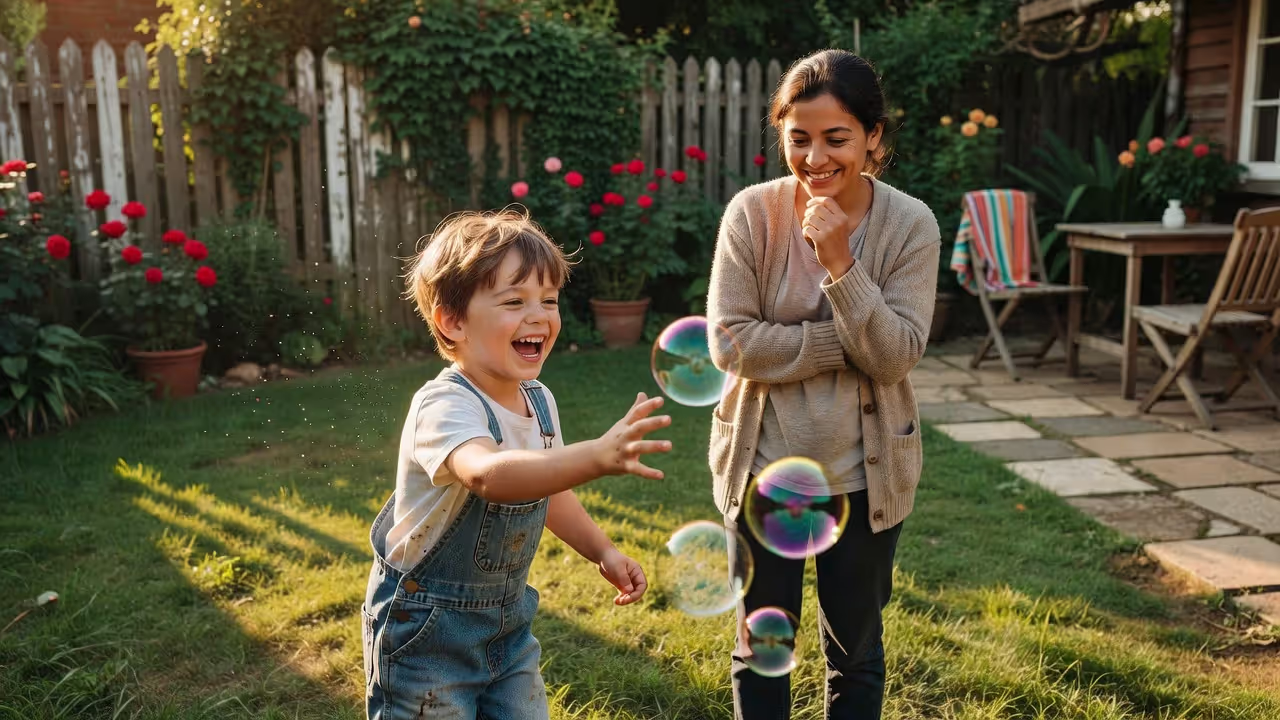
A four-year-old explaining their theory of why the moon follows the car. A teenager who suddenly, unexpectedly, tells you something real. A child who draws a picture of your family and puts you right in the center. These are the meaningful parts of being a parent that don't make it into parenting books — because they're too specific, too personal, too yours.
Milestones matter, of course. But the day-to-day texture of parenting is where most of the joy actually lives. The inside jokes. The rituals. The way your kid mispronounces something for years and you never correct them because you don't want it to end.
One thing I notice most often when parents talk about what they love: it's almost never the big events. It's the repetition. The ordinary Tuesday. The same bedtime routine for the five hundredth time. That's where the deep joy tends to settle.
Author: Olivia Brackenridge;
Source: colorfulpagescoalition.org
Don't underestimate humor, either. Kids are genuinely funny. Not in a performed way — in an accidental, unfiltered, completely honest way that adults mostly lose. Parenting gives you a front-row seat to that. It's one of the most underrated joys of the whole experience.
Long-Term Benefits of Being a Parent
The benefits of being a parent aren't always obvious in the early years. That's the honest truth. Early parenting is often exhausting, expensive, and relentless. The long-term picture looks different.
Over time, parents tend to report stronger social networks, a clearer sense of identity, and a deeper sense of purpose. These aren't small things. They're the kinds of outcomes that predict well-being across a lifetime.
| Short-Term Challenges | Long-Term Rewards |
| Sleep deprivation in infancy and toddler years | Greater sense of purpose and meaning reported in midlife |
| Financial pressure from childcare, education, and daily costs | Stronger social bonds and family support networks in older age |
| Loss of personal time and spontaneity | Personal growth: patience, empathy, resilience |
| Emotional exhaustion from constant caregiving | Legacy — the lasting impact of raising a person |
| Relationship strain between partners | Shared experience that can deepen long-term partnership |
The contrast is stark. What feels like a cost in year two often becomes a source of strength by year twenty. That doesn't mean the hard parts aren't real. It means the timeline matters.
Why parenting is rewarding over the long arc comes down to this: it gives your life a through-line. A story. Something that connects who you were to who you're becoming.
What Research Says About Health Outcomes for Parents
The benefits of being a parent extend into physical health, which surprises some people. Multiple studies have found that parents — particularly those with strong family connections — tend to live longer than non-parents. A study published in the Journal of Epidemiology and Community Health found that parents had lower mortality risk at older ages, with the effect strongest in social contexts where family support is central.
The positive aspects of parenting also show up in mental health data. Parents with grown children report some of the highest life satisfaction scores of any demographic group. The stress of early parenting doesn't erase that — it just comes first.
It's worth noting that outcomes vary. Single parents, parents without strong support systems, and parents of children with significant health challenges face a different equation. The research reflects averages, not guarantees. But the general trend is consistent: parenting, over time, tends to contribute to well-being rather than subtract from it.

Author: Olivia Brackenridge;
Source: colorfulpagescoalition.org
Positive Aspects of Parenting That Are Rarely Talked About
Most parenting conversations focus on the child. That makes sense. But some of the most meaningful parts of being a parent are actually about what happens to you.
Rediscovering curiosity is one. Children ask questions constantly — about everything. Why is the sky blue? What happens when we die? Why do people fight? Answering those questions (or admitting you can't) pulls you back into a kind of engaged wondering that adult life tends to flatten. You start to see the world as strange and interesting again.
Then there's the idea of legacy. Not in a grand, historical sense — but in the quiet knowledge that you're passing something forward. Values. Stories. A way of being in the world. That's a positive aspect of parenting that doesn't get enough attention. It gives ordinary choices a kind of weight and meaning.
Personal reinvention is another underrated reward. Many parents describe becoming someone new — not by abandoning their old self, but by discovering capacities they didn't know they had. Patience they didn't think was possible. Strength they only found when someone else needed it.
And partnerships. Raising a child together — when it works — can deepen a relationship in ways that little else can. Shared struggle creates shared meaning. The counterintuitive truth is that the hardest seasons of parenting are often the ones that bond partners most tightly.

Author: Olivia Brackenridge;
Source: colorfulpagescoalition.org
What Parents Say Is the Most Fulfilling Part of Raising a Child
Ask a hundred parents what they find most fulfilling, and you'll get a hundred specific answers. But patterns emerge.
Watching a child become themselves. That's the one that comes up most. Not achieving something. Not performing well. Just — becoming a person. Developing opinions, preferences, a sense of humor, a way of moving through the world. Parents describe watching that process as one of the most profound experiences of their lives.
Unconditional love is another. The joys of parenting are rooted, for many people, in the experience of loving someone completely — and being loved back in a way that's equally uncomplicated. Children, especially young ones, don't love you for your accomplishments. They love you because you're theirs.
The fulfillment of parenthood also shows up in moments of pride that have nothing to do with performance. Watching your child be kind to someone. Seeing them handle something hard with grace. Noticing that something you tried to teach them actually stuck. Those moments hit differently than any external achievement.
And then there's the rewards of parenting that only become clear in retrospect — when your child is grown, and you realize that the relationship you built is one of the most important things in your life. That the investment was real. That it mattered.
FAQ: Parenting Fulfillment Questions Answered
Parenting doesn't come with a guarantee of happiness. But it does come with the possibility of a kind of meaning that's genuinely hard to find anywhere else. The rewards aren't always loud or obvious. They're often quiet, slow, and deeply personal. And for most people who've raised a child, that turns out to be more than enough.
Related Stories
Read more
Read more

The content on this website is provided for general informational and educational purposes only. It is intended to explain concepts related to parenting, child development, family caregiving, adoption, fostering, and child safety.
All information on this website, including articles, guides, and examples, is presented for general educational purposes. Outcomes may vary depending on individual family circumstances.
This website does not provide professional medical, psychological, or legal advice, and the information presented should not be used as a substitute for consultation with qualified pediatricians, child psychologists, or family counselors.
The website and its authors are not responsible for any errors or omissions, or for any outcomes resulting from decisions made based on the information provided on this website.