
Punishment versus Discipline in Parenting Explained
Punishment versus Discipline in Parenting Explained

Content
Content
Parenting is full of moments where you have to make a quick call — your kid just threw food across the kitchen, or your teenager slammed a door hard enough to rattle the windows. What you do next matters more than most parents realize. The choice between punishment and discipline isn't just about the moment. It shapes how your child understands rules, relationships, and their own emotions for years to come.
What the Difference Between Discipline and Punishment Actually Means
Most people use these words interchangeably. They're not the same thing.
Punishment is reactive. It's a consequence imposed to make a child feel bad for what they did — a penalty. Grounding a kid for a week with no explanation, yelling, taking away everything they love, or spanking — these are punishments. The goal, whether conscious or not, is to cause enough discomfort that the behavior stops. The child's internal experience? Fear, shame, or resentment.
Discipline is something else entirely. The word comes from the Latin disciplina, meaning instruction or teaching. Discipline is proactive. It's about guiding a child toward understanding why a behavior is a problem and what they should do instead. A parent who practices discipline is building something — self-regulation, judgment, responsibility.
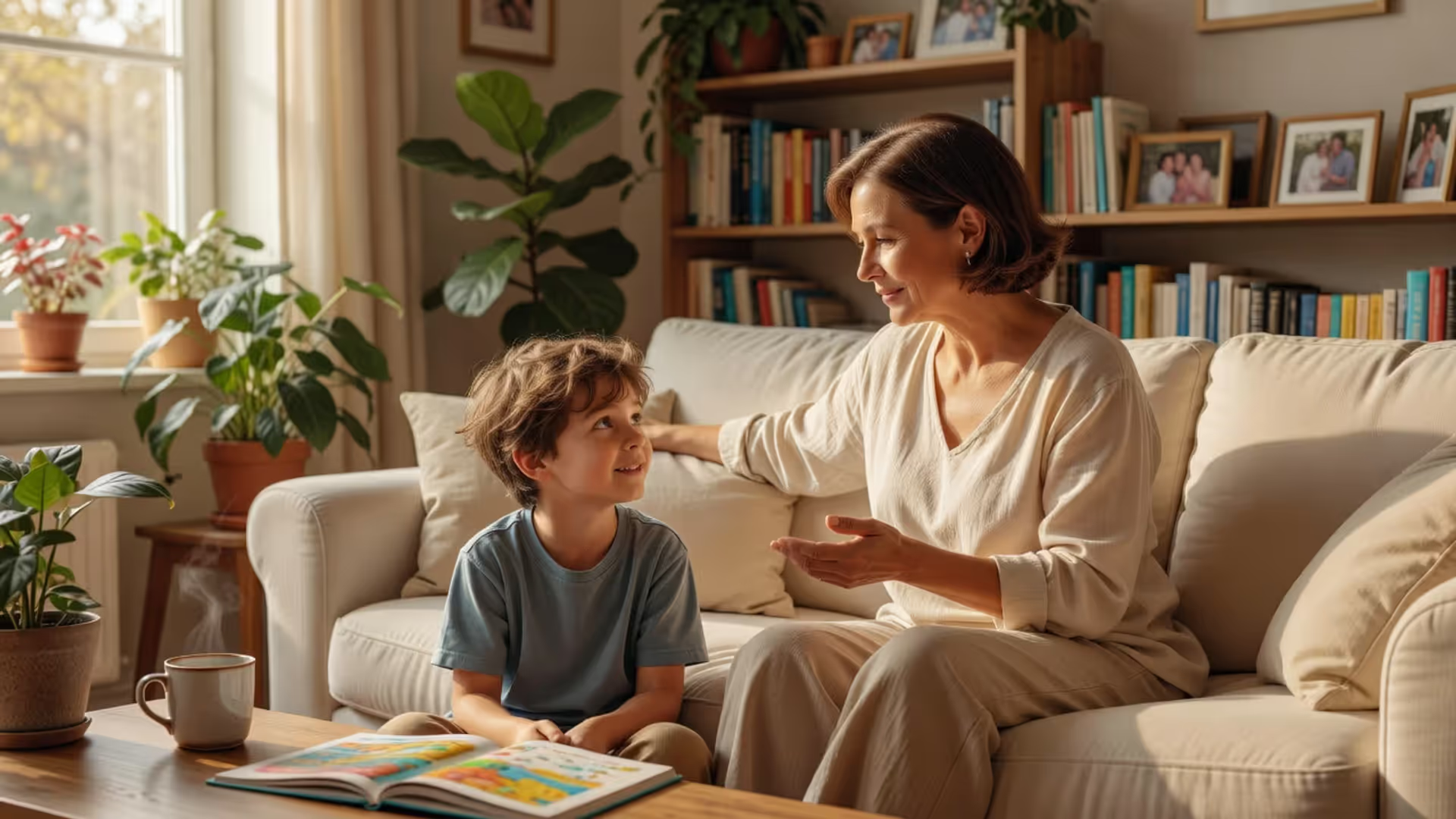
Here's a simple contrast. Your 7-year-old hits their sibling. Punishment sends them to their room and takes away screen time. Discipline sits down with them, names what happened ("You hit because you were frustrated"), sets a clear limit ("Hitting is never okay"), and works through what they could do differently next time ("Next time, walk away and tell me").
The difference between discipline and punishment comes down to intent. Punishment aims to stop behavior through pain or fear. Discipline aims to teach through connection and structure.
How Each Approach Affects a Child's Development
Short-term, punishment can work. A child who gets spanked might stop the behavior immediately. But the research on long-term outcomes is not kind to punitive approaches.
Studies consistently show that harsh punishment — especially physical punishment — is linked to increased aggression, lower self-esteem, and damaged parent-child trust. A 2021 meta-analysis published in The Lancet reviewed data from over 160,000 children and found that physical punishment was associated with worse mental health outcomes and more — not less — antisocial behavior over time.
Effective child discipline, by contrast, builds what psychologists call "self-regulation." Kids who are guided through their behavior rather than punished for it develop better emotional control, stronger problem-solving skills, and healthier relationships with authority figures. They're less likely to act out in school and more likely to internalize the values their parents are trying to teach.
The emotional response is different too. Punishment typically produces fear or defiance. Discipline, done well, produces understanding — and sometimes even cooperation. That's not idealism. That's what the developmental science actually shows.
One counterintuitive point worth making: permissiveness isn't the alternative to punishment. Letting everything slide doesn't help kids either. The goal is structure with warmth — firm limits delivered with empathy.

Author: Madeline Ashcroft;
Source: colorfulpagescoalition.org
Positive Discipline Strategies That Work at Home
Positive discipline isn't about being soft. It's about being strategic. The American Academy of Pediatrics supports discipline approaches built on connection, consistency, and teaching — not fear.
At home, that looks like a few concrete practices.
Natural consequences. Let reality do the teaching when it's safe to do so. If your child refuses to wear a jacket and it's cold outside, they get cold. You don't have to add a lecture. The experience teaches the lesson.
Positive reinforcement. Catch your kid doing something right and name it specifically. "I noticed you stopped playing and came to dinner without me asking twice — that's real responsibility." Vague praise ("Good job!") does less than specific acknowledgment.
Consistent boundaries. Rules need to be clear and enforced the same way every time. Inconsistency is one of the biggest drivers of acting-out behavior. Kids test limits when they're not sure where the limits actually are.
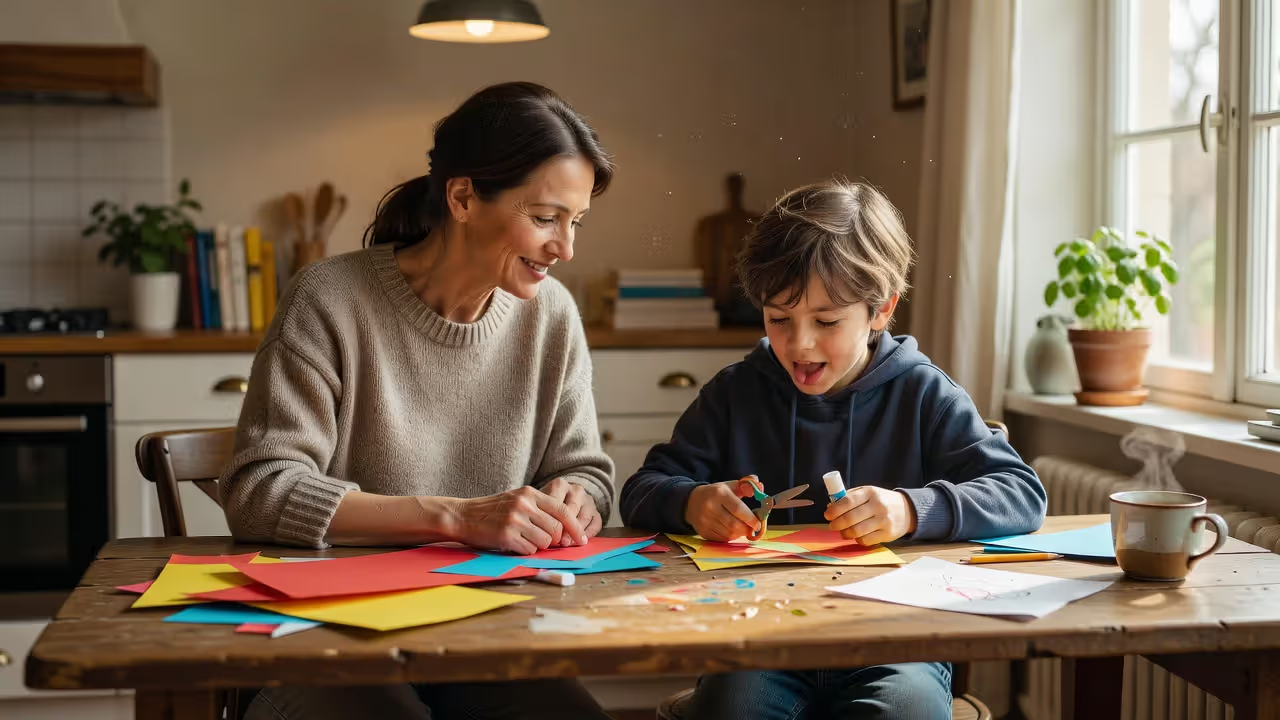
Problem-solving together. Especially with older kids, involving them in creating solutions builds buy-in. "We keep fighting about screen time every night. What do you think would be fair?" You're still the parent — you make the final call — but the conversation itself teaches negotiation and accountability.
Author: Madeline Ashcroft;
Source: colorfulpagescoalition.org
Age-Appropriate Discipline Strategies for Kids
Discipline strategies for kids need to match where a child actually is developmentally. What works for a 3-year-old won't work for a 12-year-old.
Toddlers (ages 1–3). Redirection is your main tool. Toddlers don't have the brain development to reason through consequences. If they're pulling the cat's tail, physically move them and offer something else. Short, calm statements work: "Gentle hands." Consistency matters more than complexity at this age.
School-age kids (ages 4–10). Now you can explain and reason — briefly. Natural and logical consequences land well here. If they don't put their homework in their backpack, they face the consequence at school. You can also use "cool-down" periods effectively: "Let's both take five minutes and then talk about what happened."
Preteens (ages 11–13). This group needs autonomy and respect more than almost anything. Power struggles escalate fast if you try to control everything. Pick your battles deliberately. Use collaborative problem-solving. And be honest — preteens can smell a double standard from a mile away.
How to Practice Discipline Without Punishment
Discipline without punishment doesn't mean no consequences. It means consequences that teach rather than just hurt.
Start with redirection. Before a behavior becomes a crisis, redirect the child toward something acceptable. This is especially powerful with younger kids and works faster than most parents expect.
Use logical consequences instead of arbitrary ones. There's a meaningful difference between "You broke your sister's toy so you're grounded for a month" and "You broke your sister's toy, so you'll use your own money to help replace it." The second one connects the consequence directly to the action. The child learns something real.
Calm communication is non-negotiable. You can't teach a child emotional regulation if you're dysregulated yourself. The pattern I see most often is parents escalating when their child escalates — which guarantees a power struggle. Pause. Lower your voice. Get to eye level. The conversation goes better every time.
Set clear expectations before situations arise, not during them. If you know a trip to the grocery store is hard, talk about expectations in the car on the way there — not in the cereal aisle when things are already falling apart.

Author: Madeline Ashcroft;
Source: colorfulpagescoalition.org
Punishment vs. Discipline at a Glance
| Dimension | Punishment | Discipline |
| Goal | Stop behavior through negative consequence | Teach behavior through guidance and understanding |
| Method | Penalties, removal of privileges, physical consequences | Natural/logical consequences, redirection, conversation |
| Child's emotional response | Fear, shame, resentment, defiance | Understanding, accountability, trust |
| Long-term outcome | Increased anxiety, hidden behavior, damaged relationship | Self-regulation, internalized values, stronger bond |
| Example scenario | Child lies → loses all privileges for two weeks | Child lies → discusses why it happened, loses one related privilege, practices honesty |
Children do better when they feel better. Punishment makes children feel bad, and children who feel bad do worse, not better. Encouragement, on the other hand, invites children to feel capable and connected — and that's when real change happens.
— Nelsen Jane
Common Mistakes Parents Make When Disciplining Kids
Even well-intentioned parents fall into patterns that undermine their discipline approach. Here are the most common ones.
Inconsistency. If a rule applies on Tuesday but not on Friday, it's not really a rule. Kids learn quickly which limits are real. Inconsistency teaches them to keep pushing until you give in.
Confusing discipline with control. Discipline is about teaching. If your goal is to "win" the interaction or assert dominance, you've shifted into punishment territory — even if you're not yelling. Kids can feel the difference.
Skipping the connection piece. Discipline lands better when a child feels connected to you. If the relationship is strained — especially with older kids — consequences alone won't do much. Rebuilding trust has to come first.
Lecturing too long. A 10-minute speech about why lying is wrong doesn't work on a 6-year-old. Or a 12-year-old, honestly. Make your point clearly, briefly, and stop. Less is almost always more.
Reacting in the heat of the moment. Announcing a punishment when you're furious almost always leads to something disproportionate that you'll have to walk back later. That inconsistency damages your credibility. Take a breath first.

Author: Madeline Ashcroft;
Source: colorfulpagescoalition.org
When to Seek Outside Support for Effective Child Discipline
Sometimes behavior challenges go beyond what a parenting book can address. That's not a failure — it's just reality.
Consider reaching out to a professional if your child's behavior is consistently intense, lasts longer than a few weeks, and doesn't respond to any of the approaches you've tried. Signs that outside support might help include frequent, explosive meltdowns that seem out of proportion, ongoing aggression toward others, significant regression in behavior, or a sudden dramatic change in mood or conduct.
Your first call can be your child's pediatrician. They can rule out underlying medical or developmental factors and refer you to the right specialist. Family therapists and child psychologists are trained specifically in behavior and parent-child dynamics. School counselors are another underused resource — they see your child in a completely different context and often have useful insight.
Discipline without punishment is a skill. And like any skill, sometimes you need a coach.
FAQ: Punishment and Discipline Questions Answered
The gap between punishment and discipline is really a gap between reacting and teaching. You don't have to be a perfect parent to shift toward a more discipline-focused approach — you just have to be intentional more often than not. Start small. Pick one strategy from this article and try it consistently for two weeks. Most parents are surprised by how quickly their child responds when the approach actually makes sense to them.
Related Stories

Read more

Read more



The content on this website is provided for general informational and educational purposes only. It is intended to explain concepts related to parenting, child development, family caregiving, adoption, fostering, and child safety.
All information on this website, including articles, guides, and examples, is presented for general educational purposes. Outcomes may vary depending on individual family circumstances.
This website does not provide professional medical, psychological, or legal advice, and the information presented should not be used as a substitute for consultation with qualified pediatricians, child psychologists, or family counselors.
The website and its authors are not responsible for any errors or omissions, or for any outcomes resulting from decisions made based on the information provided on this website.