
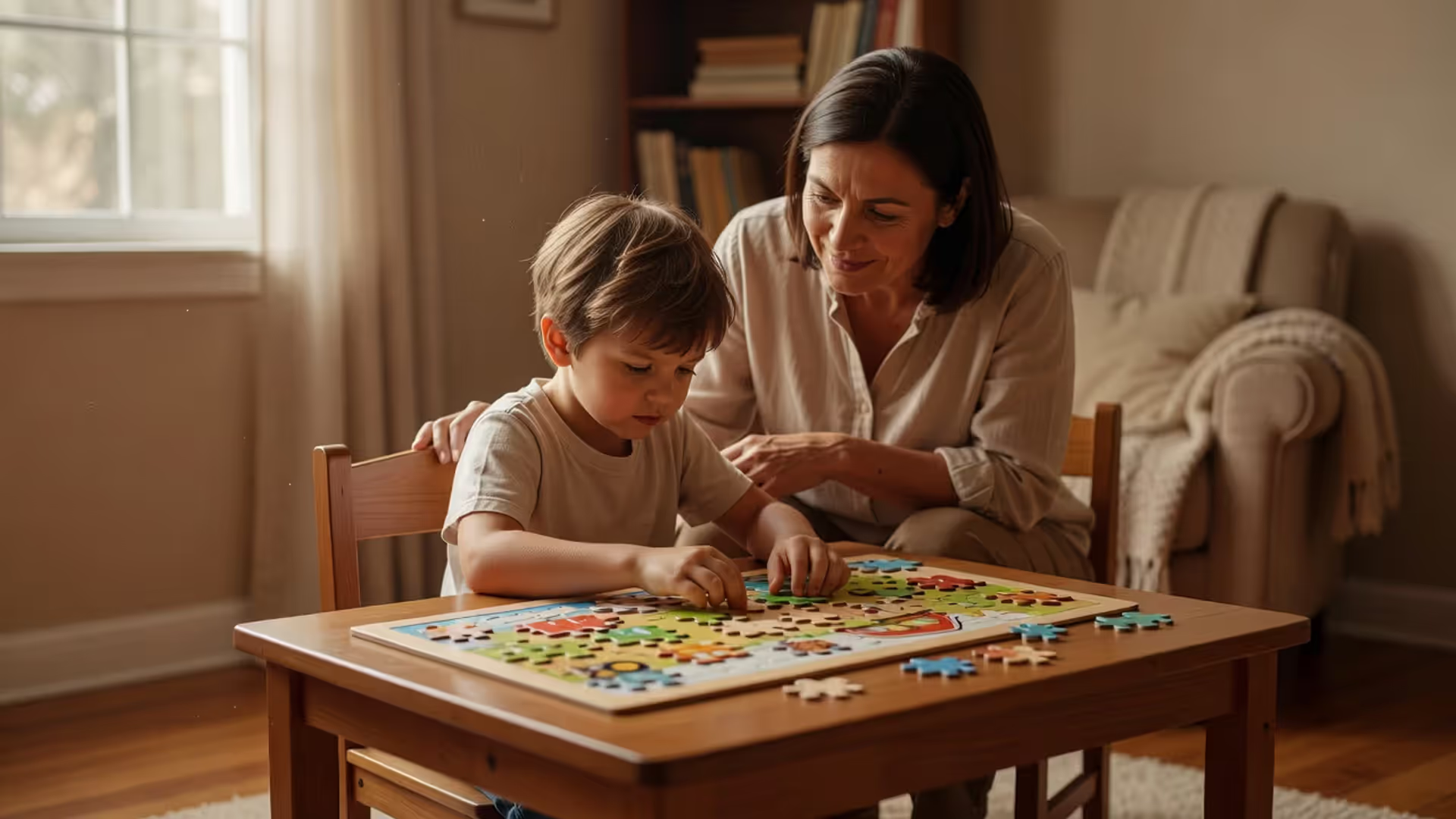
What Is Coddling and How It Affects Your Child
What Is Coddling and How It Affects Your Child?

Content
Content
Parenting is full of gray areas. But one pattern tends to show up again and again in families where kids struggle with independence, frustration, or basic problem-solving: coddling. It's not always obvious. Most parents who coddle their children aren't doing it out of laziness or indifference — they're doing it out of love. That's what makes it so easy to miss, and so hard to stop.
Coddling Meaning and Where the Term Comes From
The word "coddling" originally referred to cooking — specifically, gently simmering eggs just below a boil. The idea was to treat something fragile with extreme care to avoid breaking it. That culinary origin maps surprisingly well onto its modern meaning.
In everyday use, to coddle someone means to treat them with excessive care or protection, often shielding them from discomfort, difficulty, or consequences they'd otherwise face. In a parenting context, the coddling definition gets more specific: it describes a pattern where a parent consistently intervenes to prevent a child from experiencing failure, frustration, or natural outcomes — even when those experiences would be developmentally appropriate.
There's a difference between comforting a crying toddler and doing your 14-year-old's homework because they're stressed. Both might feel like care. Only one is coddling.
Signs You May Be Coddling Your Child
Most parents don't set out to be overprotective. It creeps in. A few common signs:
- You regularly step in before your child has a chance to try something themselves.
- You negotiate with teachers, coaches, or other adults to reduce consequences your child earned.
- You make excuses for your child's behavior to other people — and to your child.
- You can't tolerate watching your child be upset, even briefly.
- You finish tasks for them (homework, chores, projects) when they get frustrated.
- You avoid saying "no" because the resulting meltdown feels worse than just giving in.
- You pick their clothes, friends, or activities well past the age when kids typically make those choices themselves.
One or two of these occasionally? Probably not a problem. A consistent pattern across multiple areas? That's worth looking at honestly.
The common mistake here is confusing frequency with severity. Parents often think, "It's just this once." But coddling rarely happens in isolated incidents — it's a style, not a moment.
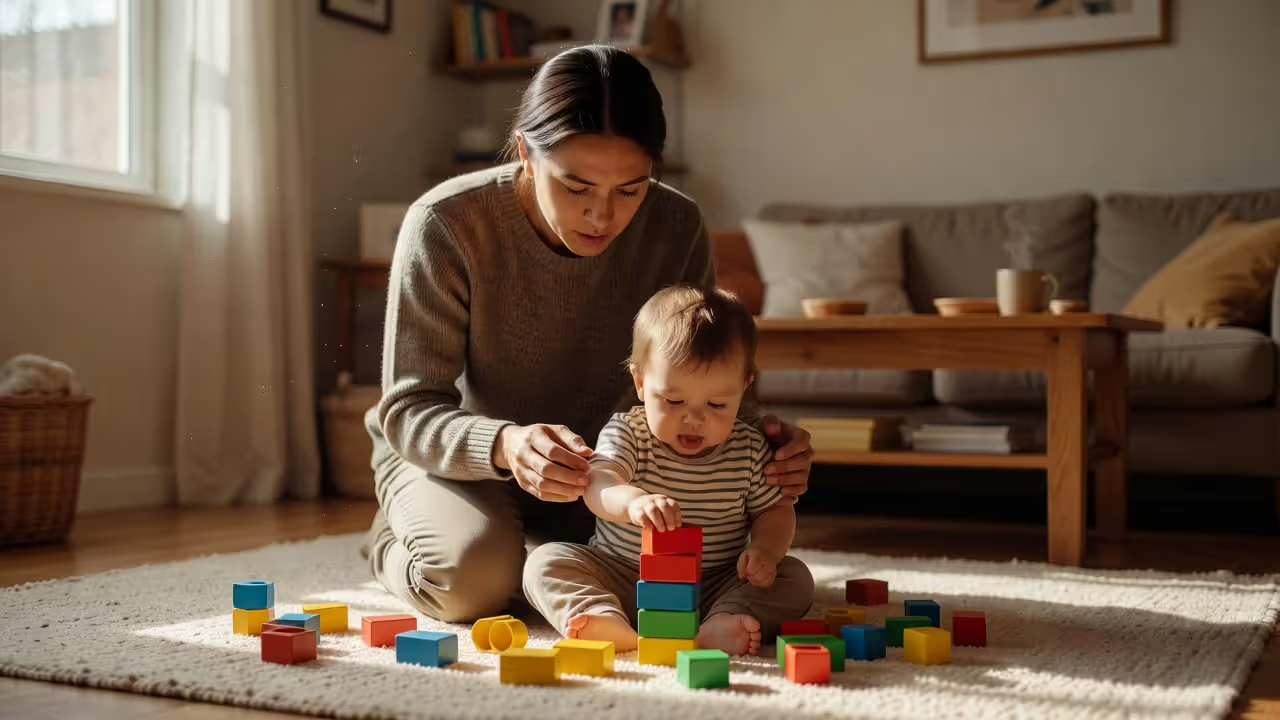
Author: Garrett Willowmere;
Source: colorfulpagescoalition.org
Coddled Child Characteristics to Watch For
Sometimes the clearest signal isn't the parent's behavior — it's the child's. Coddled child characteristics tend to cluster around a few patterns:
- Low frustration tolerance. The child gives up quickly or has outsized reactions to minor setbacks.
- Difficulty making decisions. Even small choices feel overwhelming without parental input.
- Poor conflict resolution. They expect adults to solve peer problems for them.
- Entitlement behaviors. They assume things will be arranged around their preferences.
- Anxiety in new situations. Unfamiliar environments feel threatening rather than interesting.
- Avoidance of responsibility. Mistakes are consistently blamed on others or external circumstances.
A 10-year-old who can't tie their shoes isn't necessarily coddled. But a 10-year-old who refuses to try because someone always does it for them? That's a pattern worth addressing.
Short-Term vs. Long-Term Effects of Coddling Children
The effects of coddling children don't always show up right away. Short-term, things might actually look fine — the child is happy, conflicts are minimal, and the household runs smoothly. But smooth isn't the same as healthy.
Short-term effects tend to include: reduced problem-solving attempts, increased dependency on parents for emotional regulation, and less willingness to take on challenges. These feel manageable. They're not alarming yet.
Long-term effects are where the real cost shows up. Research in developmental psychology consistently links overprotective parenting to higher rates of anxiety and depression in adolescents and young adults, weaker social skills, lower academic resilience, and difficulty in workplace settings where feedback and failure are part of the job.
The before/after picture is stark: a child who was protected from every frustration at age 8 often becomes a teenager who can't handle a bad grade, a college student who struggles to advocate for themselves, or a young adult who returns home repeatedly because independent living feels impossible.

Author: Garrett Willowmere;
Source: colorfulpagescoalition.org
| Category | Coddling Behavior | Supportive Parenting Behavior |
| Decision-making | Parent chooses for the child to avoid conflict | Parent offers limited choices, lets child decide |
| Handling failure | Parent intervenes to prevent or erase the failure | Parent acknowledges disappointment, helps child problem-solve |
| Social independence | Parent mediates all peer conflicts | Parent coaches child, then steps back |
| Emotional regulation | Parent fixes the emotion immediately | Parent validates the feeling, waits for child to self-soothe |
| Academic challenges | Parent completes or heavily edits schoolwork | Parent helps child understand, leaves execution to them |
| Risk and exploration | Parent restricts age-appropriate physical challenges | Parent sets safety boundaries, allows reasonable risk |
How Coddling Differs From Supportive Parenting
This is where a lot of parents get stuck. Nobody wants to be cold or withholding. And the line between being supportive and being overprotective can feel blurry in the moment.
Here's a useful frame: supportive parenting builds capacity. Coddling replaces it.
When you explain how to handle a conflict and then let your child try — that's support. When you call the other parent yourself because it's faster and less painful to watch — that's coddling. The outcome might look similar in the short run. The developmental impact is completely different.
Supportive parents are present. They're warm. They absolutely comfort their kids when things go wrong. But they also let things go wrong. They allow natural consequences to land. They don't rush to erase discomfort the moment it appears.
The pattern I see most often is parents who are excellent at warmth but struggle with restraint — stepping in not because it's necessary, but because waiting is uncomfortable for them.

Author: Garrett Willowmere;
Source: colorfulpagescoalition.org
How to Stop Coddling Without Pulling Away Too Fast
Stopping overprotective parenting doesn't mean becoming distant. It means shifting from doing to coaching. Here's how to start:
1. Pause before you act. When your instinct is to step in, wait 30 seconds. Ask yourself: does my child actually need me right now, or am I just uncomfortable watching them struggle?
2. Let natural consequences happen. Forgot their lunch? They'll be hungry. Didn't finish the project? They'll get a lower grade. These aren't cruelties — they're how kids learn that actions have outcomes.
3. Ask instead of tell. Instead of solving the problem, ask "What do you think you should do?" It keeps the ownership with the child.
4. Normalize failure explicitly. Talk about times you failed. Make it clear that struggling is part of learning, not a signal that something has gone wrong.
5. Expand independence gradually. Don't go from doing everything to doing nothing. Pick one area — maybe they start packing their own backpack, or handling their own bedtime routine — and hold that line consistently.
6. Manage your own anxiety separately. A lot of coddling is about the parent's discomfort, not the child's actual need. Therapy, parenting groups, or honest conversations with a partner can help you work through that without making it your child's problem.
Parental guilt is real. You'll second-guess yourself. That's normal. But guilt doesn't mean you're doing it wrong — it often means you're doing something that's actually harder and more loving than the easy fix.

Author: Garrett Willowmere;
Source: colorfulpagescoalition.org
What Experts and Researchers Say About Overprotective Parenting
Child development researchers have been studying the effects of overprotective parenting for decades, and the findings point in a consistent direction: kids need age-appropriate struggle to develop resilience, confidence, and coping skills.
Dr. Wendy Mogel, clinical psychologist and author of The Blessing of a Skinned Knee, has written extensively about how well-meaning parents can inadvertently undermine their children's development by removing every obstacle from their path. Her work emphasizes that children need to experience manageable failure — not protected from it.
We want our children to have everything we didn't have and to spare them everything we did have. This is a recipe for disaster.
— Mogel Wendy
Research published through the American Psychological Association links overprotective parenting styles to measurable increases in childhood anxiety disorders. One frequently cited finding is that children of highly controlling parents score significantly lower on measures of self-efficacy — the belief that their own actions can produce positive outcomes. That belief, or the lack of it, shapes behavior for decades.
It's not just about confidence, either. Social development takes a hit. Kids who haven't been allowed to navigate conflict, disappointment, or uncertainty on their own often struggle in peer relationships, school environments, and eventually workplaces where no one is there to smooth the path.
FAQ: Coddling and Overprotective Parenting Questions Answered
Changing a coddling pattern takes time, and it won't feel natural at first. But every time you hold back and let your child work through something on their own — even something small — you're giving them something no amount of protection can provide: the experience of being capable.
Related Stories

Read more

Read more



The content on this website is provided for general informational and educational purposes only. It is intended to explain concepts related to parenting, child development, family caregiving, adoption, fostering, and child safety.
All information on this website, including articles, guides, and examples, is presented for general educational purposes. Outcomes may vary depending on individual family circumstances.
This website does not provide professional medical, psychological, or legal advice, and the information presented should not be used as a substitute for consultation with qualified pediatricians, child psychologists, or family counselors.
The website and its authors are not responsible for any errors or omissions, or for any outcomes resulting from decisions made based on the information provided on this website.