

Adolescence Emotional Development Explained for Parents and Teens
Adolescence Emotional Development Explained for Parents and Teens

Adolescence is a wild ride — for teens and for everyone around them. One minute they're laughing with you at dinner, the next they've slammed a door and disappeared into their room. That emotional whiplash isn't random, and it isn't a character flaw. It's the predictable result of a brain that's being rewired from the inside out. Understanding adolescence emotional development helps parents respond with patience instead of frustration, and helps teens make sense of their own inner chaos.
What Happens to the Brain During Adolescence
The teenage brain isn't just a smaller adult brain. It's structurally different — and those differences explain almost everything about emotional changes during adolescence.
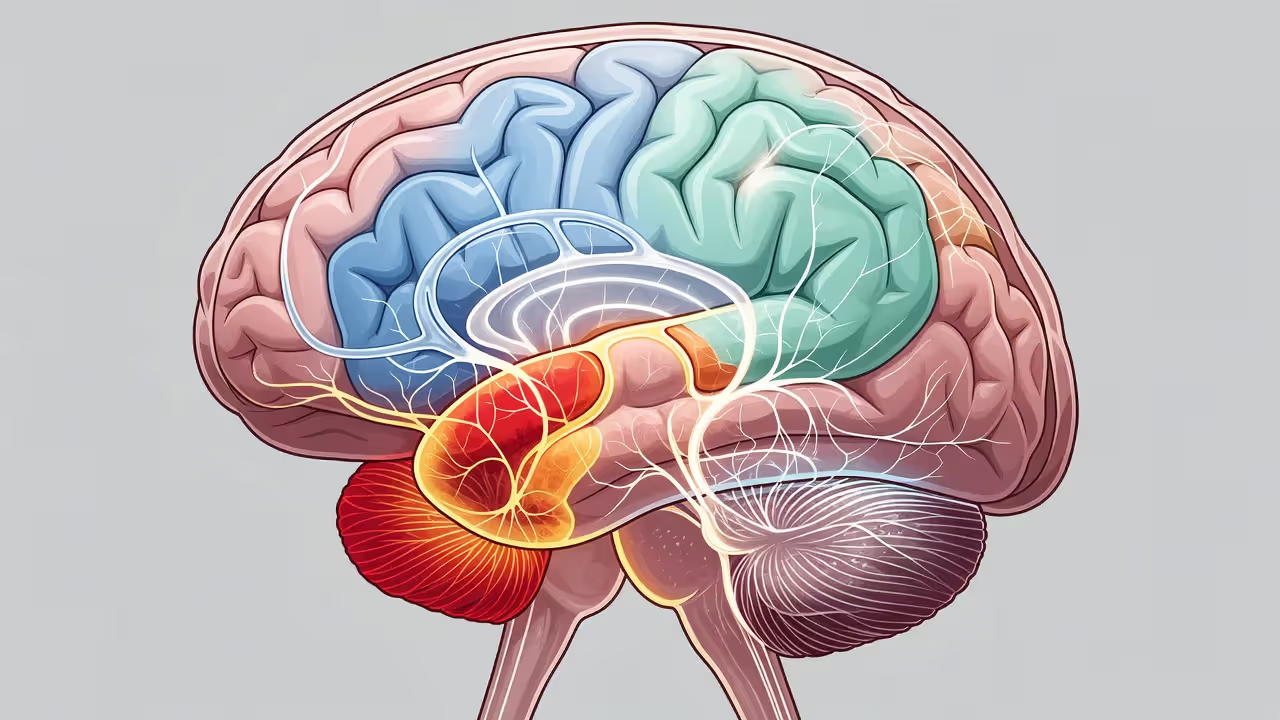
The adolescent brain development process involves two systems that mature on very different timelines. The limbic system — the brain's emotional engine — surges in activity right around puberty. It drives reward-seeking, emotional intensity, and social sensitivity. The prefrontal cortex, which handles planning, impulse control, and rational decision-making, doesn't fully mature until the mid-to-late twenties.
That gap matters enormously. A 14-year-old isn't being dramatic on purpose. Their emotional accelerator is floored while their brakes are still being installed.
Hormonal shifts compound this. Rising levels of estrogen, testosterone, and cortisol directly influence mood regulation circuits. Dopamine pathways become hypersensitive to social rewards — which is why peer approval feels life-or-death to a teenager. It's not immaturity. It's neuroscience.
Emotional development in teenagers is also shaped by sleep disruption. The adolescent circadian rhythm shifts naturally toward later sleep and wake times, and chronic sleep deprivation amplifies emotional reactivity by 30–40% according to research from the National Sleep Foundation. Less sleep equals bigger feelings, with fewer resources to manage them.
Author: Madeline Ashcroft;
Source: colorfulpagescoalition.org
Common Emotional Changes During Adolescence by Age
Emotional development in teenagers doesn't follow a single script. It unfolds in stages, each with its own flavor of intensity, confusion, and growth. Broadly, researchers divide adolescence into three phases: early, middle, and late.
Early Adolescence (Ages 10–13)
This is when the emotional rollercoaster first leaves the station. Kids in this stage experience sudden mood shifts that can baffle even the most patient parent. Self-consciousness spikes. Peer relationships start to matter more than family approval — sometimes overnight. Emotional outbursts are common and often disproportionate to the trigger.
Middle Adolescence (Ages 14–16)
Risk-taking peaks here. Teens in this stage are intensely focused on identity, independence, and social status. Emotional conflicts with parents tend to escalate. Romantic feelings emerge, bringing new emotional complexity. This is also the stage when anxiety and depression most commonly surface for the first time.
Late Adolescence (Ages 17–19)
Emotional stability starts to return — slowly. Teens develop a more consistent sense of self. Empathy deepens. Long-term thinking improves. Conflicts with parents typically decrease as teens gain confidence in their own identity and adults begin to treat them more like peers.
| Stage | Typical Emotional Traits | Common Mood Patterns | Key Developmental Tasks | Red Flags to Watch For |
| Early (10–13) | Self-conscious, impulsive, emotionally reactive | Rapid, unpredictable mood swings | Adjusting to puberty; forming peer identity | Persistent withdrawal, school refusal, self-harm |
| Middle (14–16) | Identity-focused, risk-tolerant, socially intense | Conflict-heavy, emotionally volatile | Identity exploration; independence from family | Ongoing hopelessness, substance use, isolation |
| Late (17–19) | More stable, empathetic, future-oriented | Calmer overall, situational stress spikes | Solidifying identity; planning for adulthood | Severe anxiety, inability to function, persistent low mood |

Author: Madeline Ashcroft;
Source: colorfulpagescoalition.org
Key Adolescent Emotional Milestones to Watch For
Not all emotional changes during the teen years signal trouble. Many of them are signs of healthy growth. The pattern I see most often is parents misreading normal developmental milestones as problems — and that misread can actually slow a teen's progress by adding unnecessary conflict.
Here are the adolescent emotional milestones worth recognizing:
Identity formation. Between ages 12 and 18, teens experiment with values, beliefs, and roles. Erik Erikson called this the "identity vs. role confusion" stage. It's messy. That's the point.
Empathy expansion. Younger teens are notoriously self-centered — and that's developmentally appropriate. But by mid-to-late adolescence, most teens develop a much richer capacity for perspective-taking and genuine empathy toward others.
Emotional self-awareness. Teens gradually learn to name their emotions rather than just act on them. A 12-year-old might slam a door; a 17-year-old might say "I'm feeling overwhelmed and I need space." That shift is huge.
Peer attachment. Deep friendships become a training ground for adult relationships. Teens learn trust, conflict resolution, and vulnerability through these bonds. Losing a friendship at 15 can feel as devastating as a breakup — because emotionally, it is.
Autonomy and healthy separation. Pushing back against parental authority isn't defiance for its own sake. It's how teens build the confidence to eventually function independently. Teen emotional growth depends on having enough room to make — and recover from — small mistakes.
Mood Changes in Adolescence vs. Signs of a Bigger Problem
This is where parents often feel most lost. Mood changes in adolescence are normal. But some emotional patterns cross a line that deserves professional attention.
Normal mood changes typically look like: irritability that passes within hours or a day, sadness tied to a specific event (a breakup, a failed test), occasional withdrawal that doesn't last more than a few days, and conflicts that resolve without lasting damage to the relationship.
Warning signs look different. Think persistent sadness lasting two weeks or more with no clear cause. Loss of interest in things the teen previously loved. Significant changes in sleep or appetite. Talk of hopelessness, worthlessness, or death. These aren't just "bad moods." They may indicate clinical depression or anxiety.
A useful comparison: normal mood swings are like weather — they change. A depressive episode is more like a season — it settles in and doesn't lift on its own.
One counterintuitive point worth knowing: teens with anxiety often present as angry or irritable, not visibly anxious. If your teen seems constantly on edge or snapping at everyone, anxiety may be the underlying driver, not attitude.

Author: Madeline Ashcroft;
Source: colorfulpagescoalition.org
How Emotional Regulation in Adolescence Develops Over Time
Emotional regulation in adolescence doesn't arrive fully formed. It builds — slowly, unevenly, and with plenty of setbacks along the way.
Young teens rely heavily on external regulation: a parent calming them down, a coach offering structure, a friend validating their feelings. Over time, they internalize these strategies and begin to self-regulate. By late adolescence, most teens can pause before reacting, use distraction or reframing to manage distress, and recover from emotional upsets more quickly than they could at 12.
What speeds this development up? Consistent, warm relationships with adults who model healthy emotional expression. Clear but flexible boundaries. Opportunities to experience and recover from manageable stress — not a stress-free environment.
What slows it down? Chronic trauma or instability at home. Dismissive responses to emotional expression ("you're overreacting"). Over-reliance on substances or screens as coping tools. These don't just delay emotional regulation — they can create lasting patterns that follow teens into adulthood.
Adolescence is a period of dramatic change in the brain's reward circuitry, and this change is at the heart of many of the behavioral and emotional shifts we see during the teen years.
— Steinberg Laurence
Impulse control, specifically, follows a predictable arc. It's weakest in early adolescence, improves through the middle years, and approaches adult levels by around age 18–20. But under stress or in emotionally charged situations — especially with peers watching — even older teens can revert to more impulsive patterns. That's not failure. That's how the developing brain works under pressure.
How Parents and Educators Can Support Teen Emotional Growth
Supporting teen emotional growth doesn't mean solving every problem. It means staying present while teens do the hard work themselves.
A few things that actually help:
Stay curious, not reactive. When a teen shares something emotionally charged, ask questions before offering solutions. "What was that like for you?" goes further than "Here's what you should do."
Name emotions out loud yourself. Adults who model emotional vocabulary — "I'm feeling frustrated right now and I need a minute" — give teens a living example of emotional regulation in action.
Avoid the lecture trap. Long explanations of why a teen's feelings are wrong tend to shut conversations down. Short, validating responses keep them open.
Maintain connection even during conflict. Research by psychologist John Gottman found that teens who feel emotionally connected to at least one adult are significantly more resilient across nearly every measure. The relationship itself is the intervention.
For educators: structure and predictability reduce emotional reactivity in the classroom. Teens who know what to expect can focus more energy on learning and less on managing uncertainty. Brief check-ins — even 60 seconds one-on-one — can make a measurable difference for struggling students.
One common mistake: trying to eliminate all emotional discomfort for teens. Discomfort is where emotional growth actually happens. The goal isn't a stress-free teen. It's a teen who has the skills to move through stress.

Author: Madeline Ashcroft;
Source: colorfulpagescoalition.org
Frequently Asked Questions About Adolescent Emotional Development
Adolescence emotional development is one of the most intense, disorienting, and ultimately remarkable processes a human being goes through. It's not something to fix — it's something to support. For parents, that means staying in the relationship even when it's hard. For educators, it means building environments where emotional expression is safe. And for teens themselves, it means knowing that the chaos you feel right now isn't permanent. Your brain is doing exactly what it's supposed to do.
Related Stories

Read more

Read more



The content on this website is provided for general informational and educational purposes only. It is intended to explain concepts related to parenting, child development, family caregiving, adoption, fostering, and child safety.
All information on this website, including articles, guides, and examples, is presented for general educational purposes. Outcomes may vary depending on individual family circumstances.
This website does not provide professional medical, psychological, or legal advice, and the information presented should not be used as a substitute for consultation with qualified pediatricians, child psychologists, or family counselors.
The website and its authors are not responsible for any errors or omissions, or for any outcomes resulting from decisions made based on the information provided on this website.