
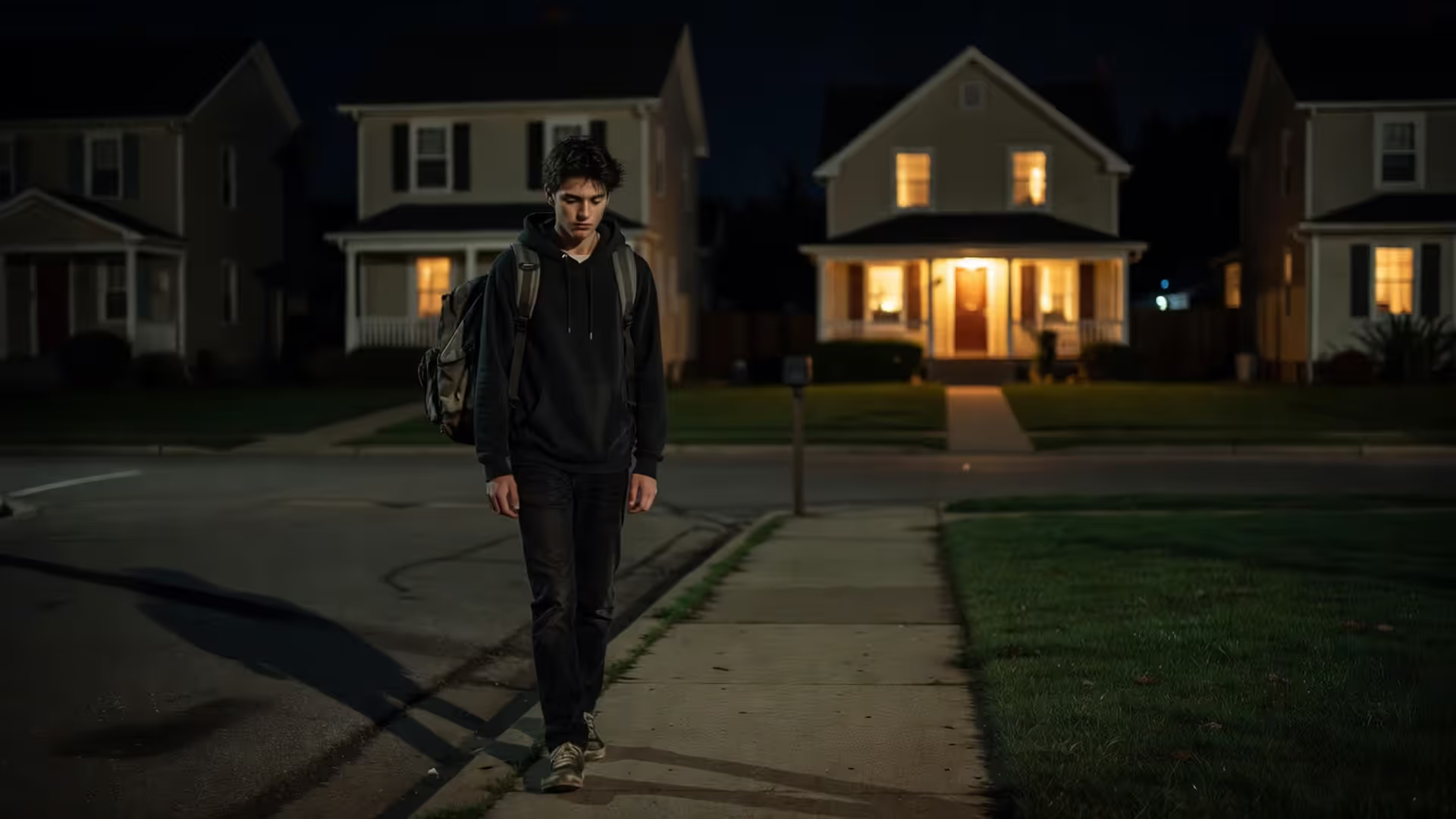
Do Curfews Keep Teens Out of Trouble
Do Curfews Keep Teens Out of Trouble?

Every parent has asked the same question at some point: if my teen has to be home by a certain time, does that actually stop them from getting into trouble? It's a fair question, and the answer isn't as simple as yes or no. Curfews are one of the most debated tools in both parenting and public policy — backed by some research, challenged by other studies, and shaped heavily by how they're actually enforced. Whether you're weighing a house rule or curious about your city's ordinance, here's what the evidence and experience actually show.
What the Research Actually Says About Teen Curfews
The short answer: curfews have mixed results, and the research reflects that.
Some studies suggest that municipal curfew laws correlate with modest reductions in nighttime juvenile arrests. A 1996 report from the U.S. Conference of Mayors found that many cities reported drops in youth crime after implementing curfew ordinances. That sounds promising. But correlation isn't causation, and later research complicates the picture significantly.
A 2016 review published in the Journal of Criminal Law and Criminology analyzed data from dozens of U.S. cities and found little to no consistent evidence that curfew laws reduce juvenile crime rates overall. In some cases, daytime offenses actually increased — possibly because teens displaced their behavior to hours not covered by the curfew. That's a counterintuitive finding that gets overlooked in most curfew debates.
Parental curfews, on the other hand, tend to fare better in research on adolescent outcomes. When a curfew is part of a broader pattern of parental involvement — knowing where your teen is, who they're with, and what they're doing — it's associated with lower rates of substance use and delinquency. The curfew itself isn't the magic ingredient. It's the parental engagement around it.
So are curfews effective for teens? Possibly, but only under specific conditions. A blanket rule with no communication behind it tends to fail. A curfew embedded in a trusting, involved relationship tends to support better outcomes.
Curfew laws give politicians something to point to, but the data consistently shows they do not reduce youth crime. They primarily serve to criminalize normal teenage behavior and burden families who are already doing their best.
— Males Mike
How Curfews Are Enforced Across the US
Curfew enforcement in the US operates on two very different levels: government ordinances and household rules. They don't always align, and understanding the difference matters.
Municipal Curfew Laws vs. Parental Rules
Most major U.S. cities have some form of juvenile curfew law on the books. These ordinances typically prohibit minors under 17 or 18 from being in public spaces during certain hours — usually between 11 p.m. and 6 a.m. on weeknights, with slightly later cutoffs on weekends. Cities like Dallas, Chicago, and Washington D.C. have enforced curfews for decades, though the specifics vary widely.
Some ordinances include exceptions for teens traveling to or from work, attending supervised events, or responding to emergencies. Others are stricter. A few cities have experimented with daytime curfews during school hours to address truancy.
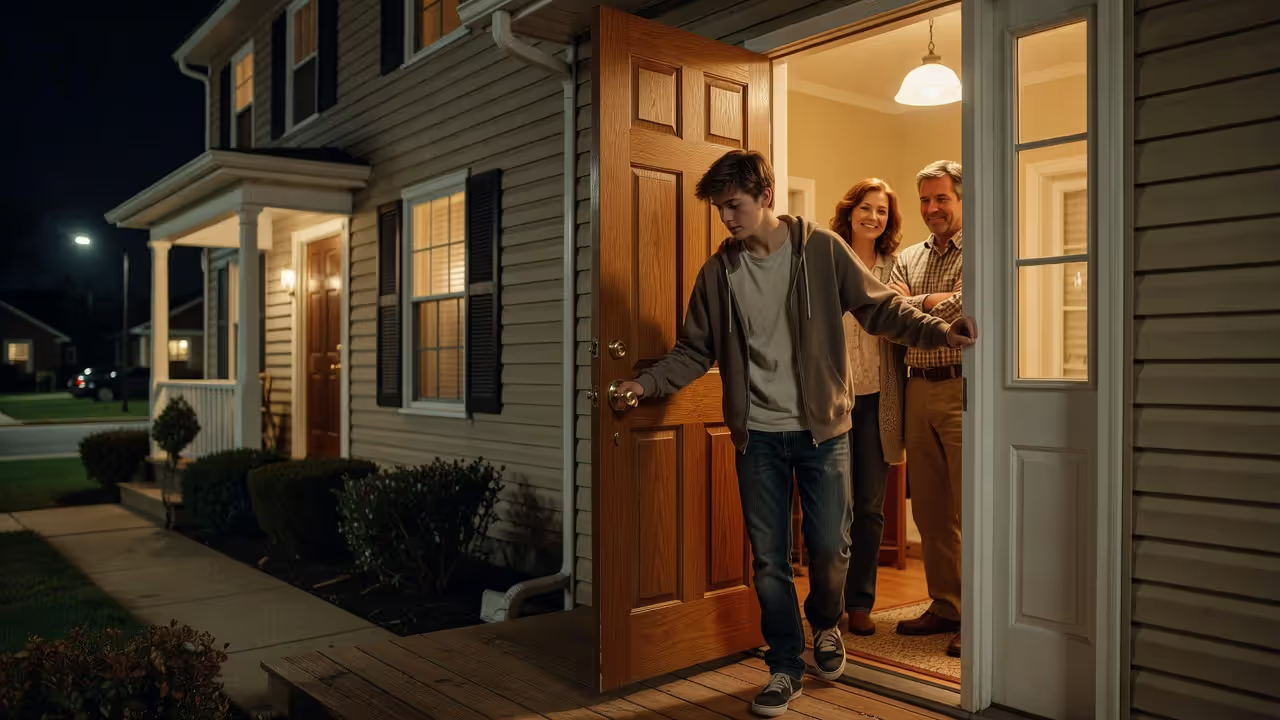
Parental curfews are a separate matter entirely. They're informal agreements — or firm rules, depending on your household — that don't carry legal weight but can carry serious consequences within the family. Most parents set curfews earlier than local law requires, and that's completely their right.
Author: Rebecca Thornfield;
Source: colorfulpagescoalition.org
Consequences for Violating a Curfew
Breaking a municipal curfew can lead to a minor being detained, taken to a police station, and released to a parent or guardian. In most jurisdictions, a first offense results in a warning or a small fine. Repeat violations can escalate to mandatory counseling, community service, or involvement of the juvenile court system.
At home, consequences vary by family. Common responses include loss of driving privileges, restricted phone access, earlier curfew times, or grounding. The pattern I see most often is that inconsistent enforcement — where violations sometimes get punished and sometimes don't — produces the worst outcomes. Teens learn to test the rule rather than respect it.

Author: Rebecca Thornfield;
Source: colorfulpagescoalition.org
Teenage Curfew Pros and Cons Worth Considering
No parenting tool is perfect. Curfews come with real benefits and real drawbacks, and knowing both helps you make a smarter decision for your family.
| Pro | Con |
| Provides a clear safety boundary during high-risk nighttime hours | Can feel arbitrary to teens, damaging trust if not explained |
| Reduces exposure to unsupervised situations involving alcohol or drugs | Overly strict curfews may push rebellion rather than prevent it |
| Gives parents peace of mind and a concrete check-in point | Doesn't address root causes of risky behavior |
| Reinforces family communication and accountability | Teens with strict curfews may feel socially excluded from peers |
| Can be a starting point for broader conversations about responsibility | Enforcement inconsistency makes the rule ineffective quickly |
| Supports healthy sleep habits, especially on school nights | May penalize responsible teens who've earned more freedom |
The benefits of teen curfews are most visible when the rule is explained, fair, and part of an ongoing relationship. The drawbacks tend to dominate when curfews are imposed without discussion or enforced selectively.
One thing that surprises many parents: research suggests that teens who feel their curfew is reasonable and understand the reasoning behind it are far more likely to follow it. Arbitrary rules breed resentment. Explained rules breed compliance — not always, but significantly more often.
What Makes a Reasonable Curfew for Teens
Age matters. So does the day of the week, the teen's track record, and what they're actually doing.
A reasonable curfew for teens typically scales with age and demonstrated responsibility. Here's a general framework most child development experts support:
- Ages 13–14: 9:00–9:30 p.m. on weekends; home before dark on school nights
- Ages 15–16: 10:00–10:30 p.m. on weekends; 9:00 p.m. on school nights
- Ages 17–18: 11:00 p.m. to midnight on weekends; 10:00 p.m. on school nights
These aren't hard rules — they're starting points. A 16-year-old who's consistently responsible, communicates well, and has a solid school record might reasonably earn a later curfew. A 17-year-old who's been dishonest about where they've been probably hasn't.
School nights deserve a stricter limit. Sleep deprivation in teens is a real problem — the American Academy of Pediatrics recommends 8–10 hours of sleep for adolescents, and staying out until 11 p.m. on a Tuesday makes that nearly impossible. A 9:00 or 9:30 p.m. school-night curfew isn't about control. It's about protecting sleep and morning function.
Special occasions are worth handling separately. A school dance, a graduation party, a New Year's Eve event — these can have one-time extended curfews negotiated in advance. That flexibility actually reinforces the relationship. It shows you're paying attention to context, not just enforcing a blanket rule.

Author: Rebecca Thornfield;
Source: colorfulpagescoalition.org
How to Set Teen Curfew Rules That Actually Work
Setting a curfew for teenagers isn't just about picking a time. It's about building a system that actually functions.
Start by involving your teen in the conversation. This doesn't mean letting them set their own curfew — you're still the parent. But asking for their input ("What time do you think is fair on weekends?") does two things: it gives you useful information about their social life, and it makes them more likely to respect the outcome. Teens who feel heard comply more consistently.
Be specific about what the curfew means. "Home by 10" should mean inside the house, not pulling into the driveway. If texting an update is acceptable in place of physical presence under certain conditions, say so explicitly. Vague rules create loopholes — and teens are excellent at finding them.
Before/after example: A parent who says "just be home at a reasonable hour" and then gets angry when their teen walks in at midnight has created a problem through ambiguity. A parent who says "10:30 p.m. on Saturdays, text me by 10 if plans change" gives their teen a clear target and a built-in communication path.
Tie the curfew to trust, not just time. Make it clear that consistently respecting the curfew is how a teen earns a later one. That reframes the rule as a pathway to more freedom rather than a restriction. Most teens respond better to that framing.
Common Mistakes Parents Make When Setting Curfews
The most common mistake isn't being too strict or too lenient — it's being inconsistent. If your teen breaks curfew and sometimes faces consequences and sometimes doesn't, they'll test the rule every time. Consistency matters more than strictness.
A close second: setting the same curfew for years without revisiting it. A 17-year-old with a 9:30 p.m. curfew that was set when they were 14 has no incentive to prove themselves. Rules should evolve as teens mature. Failing to update them sends the message that you're not paying attention.
Parents also frequently skip the "why." Telling a teen "be home by 10 because I said so" is a guarantee of resentment. Explaining that nighttime hours carry statistically higher risks, that you want to know they're safe, and that you're building toward giving them more independence — that's a conversation that actually lands.
And don't set a curfew you can't enforce. If you go to bed at 9:30 and your teen's curfew is 11, you need a system — a check-in text, a sound alert when the door opens, something. An unenforced rule is worse than no rule at all.

Author: Rebecca Thornfield;
Source: colorfulpagescoalition.org
FAQ: Teen Curfew Questions Answered
Curfews can be a useful tool, but they're not a guarantee. The teens who stay out of trouble most consistently aren't usually the ones with the strictest curfews — they're the ones whose parents are engaged, whose rules make sense, and who've been given real reasons to come home on time. A curfew works best when it's one part of a larger relationship built on communication and earned trust. Get that part right, and the specific time on the clock matters a lot less.
Related Stories

Read more

Read more



The content on this website is provided for general informational and educational purposes only. It is intended to explain concepts related to parenting, child development, family caregiving, adoption, fostering, and child safety.
All information on this website, including articles, guides, and examples, is presented for general educational purposes. Outcomes may vary depending on individual family circumstances.
This website does not provide professional medical, psychological, or legal advice, and the information presented should not be used as a substitute for consultation with qualified pediatricians, child psychologists, or family counselors.
The website and its authors are not responsible for any errors or omissions, or for any outcomes resulting from decisions made based on the information provided on this website.