
Real Benefits of Social Media for Youth Explained
Real Benefits of Social Media for Youth Explained

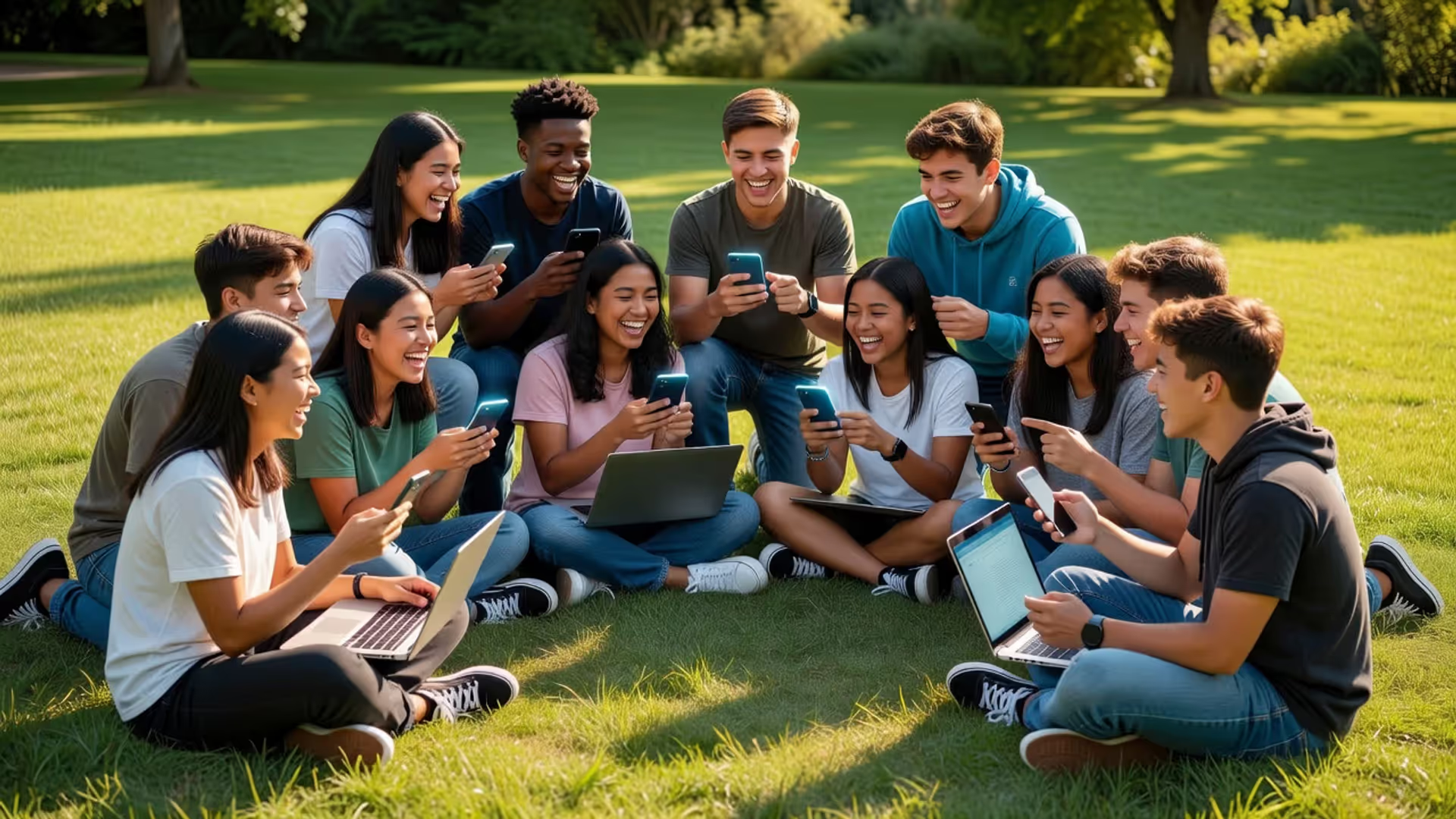
Social media gets a bad reputation. Parents worry, headlines warn, and school counselors hand out screen time guides like they're going out of style. But the full picture is more complicated — and more hopeful — than the panic suggests. When young people use social media with intention and some basic guardrails, the benefits of social media for youth are real, measurable, and worth talking about honestly.
This isn't a defense of doom-scrolling or a dismissal of legitimate concerns. It's a look at what the research actually shows, what healthy use looks like in practice, and why writing off social media entirely misses the point.
How Social Media Helps Teens Build Meaningful Connections
Humans are wired for connection. Teens especially. And social media, at its best, is a connection tool.
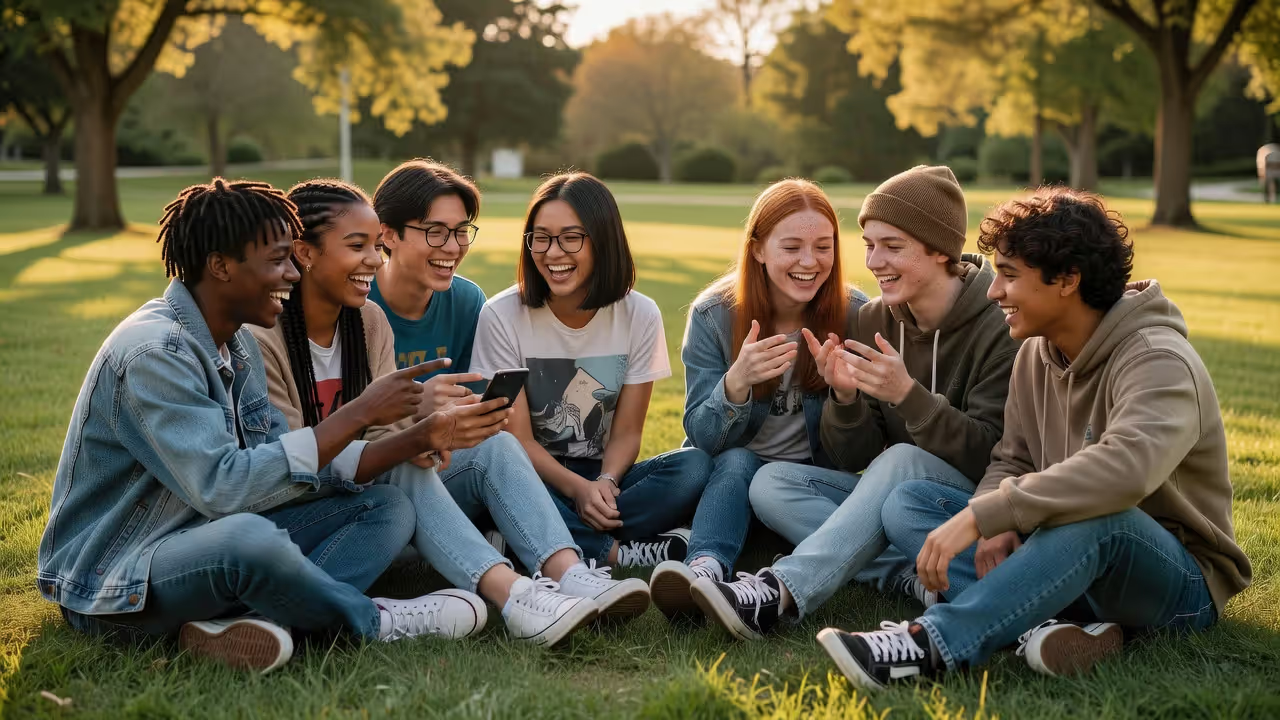
Think about the kid who moves across the country in ninth grade. Before platforms like Instagram or Discord existed, that move meant losing your friend group almost entirely. Now? Those friendships can survive — and sometimes even deepen — through regular digital contact. Research from the Pew Research Center found that roughly 80% of teens say social media helps them feel more connected to their friends' lives. That's not a trivial number.
Social media benefits for young people extend beyond just keeping up with people they already know. For teens who feel isolated in their immediate environment — whether because of geography, identity, or interest — online communities can be the first place they find genuine belonging. The kid obsessed with astrophysics in a small town. The queer teenager in a conservative school district. The aspiring musician with no one in their neighborhood who shares that passion.
And here's a counterintuitive point: social media and teen connection doesn't always mean shallow interaction. Plenty of teens form close, lasting relationships through platforms that started as casual follows. The quality of connection depends far more on how social media is used than on the fact that it's digital.
Author: Olivia Brackenridge;
Source: colorfulpagescoalition.org
Positive Effects of Social Media on Teen Mental Health
This is where the conversation gets nuanced. Social media's relationship with teen mental health isn't simple — it's not universally good or universally damaging. Context matters enormously.
The positive effects of social media on teens show up most clearly when young people are using platforms to connect, create, and find community rather than to compare and compete. Teens who join support groups for anxiety, chronic illness, or grief often report feeling less alone. That's not a minor benefit. Isolation is one of the strongest predictors of poor mental health outcomes in adolescence.
When Online Communities Provide Real Emotional Support
Some teens simply don't have access to in-person mental health support. Whether that's because of cost, geography, stigma, or family dynamics, the gap is real. Online communities — from Reddit threads to private Facebook groups to Discord servers — can fill part of that gap.
A teenager managing depression who finds a moderated online community of peers going through similar experiences gets something concrete: validation, shared coping strategies, and the knowledge that they're not uniquely broken. That matters. It doesn't replace therapy, but it can be a genuine bridge.
The relationship between social media and teen wellbeing is not one-size-fits-all. For many young people, online connection serves as a genuine source of support — particularly for those who lack access to mental health resources in their immediate communities.
— Twenge Jean
Signs That Social Media Use Is Healthy vs. Harmful
The pattern I see most often is teens and parents treating social media as all-or-nothing. But the real question is: what's the emotional outcome? Healthy use typically leaves a teen feeling energized, inspired, or connected. Harmful use tends to leave them feeling worse about themselves, anxious, or compulsively checking for validation.
Watch for the difference between active and passive use. Posting, creating, messaging, and engaging is generally associated with better outcomes than silently scrolling through curated highlight reels of other people's lives.
Social Media as a Learning Tool for Young People
Social media is one of the most underrated educational platforms available to young people right now. That might sound like a stretch, but the evidence backs it up.
YouTube alone hosts more instructional content than most school libraries. Teens are learning to code, speak new languages, understand investing basics, study for the SAT, and explore college options — all through social platforms. TikTok's educational side, often tagged under #LearnOnTikTok, has generated billions of views on science, history, and practical life skills content.
The advantages of social media for youth in education go beyond passive consumption. Platforms like Google Classroom integrate with social-style features. Study groups form on Discord. Teens collaborate on projects across time zones. Exposure to diverse perspectives — something that's genuinely hard to manufacture in a classroom — happens organically when a teenager follows creators from different countries, backgrounds, and disciplines.
One concrete example: a high school student in rural Kansas who wants to study environmental science can follow actual researchers, watch field work in real time, and participate in citizen science projects — all through social media. That access simply didn't exist a generation ago.
For more on how adolescent development intersects with digital environments, the research base has grown substantially in recent years and offers useful frameworks for parents and educators.

Author: Olivia Brackenridge;
Source: colorfulpagescoalition.org
How Teens Use Social Media to Explore Identity and Creativity
Adolescence has always been about figuring out who you are. Social media just gives that process a wider canvas.
Platforms like TikTok, YouTube, and Instagram have turned content creation into a legitimate skill — and for many teens, it's also a form of self-expression that rivals anything they'd do with a journal or sketchbook. A teenager who starts making short films for YouTube is developing storytelling, editing, pacing, and audience awareness. Those are real skills.
The advantages of social media for youth in creative development are especially visible in music, visual art, and writing communities. Young artists get feedback from real audiences, not just teachers. They iterate. They improve. Some of them build careers before they graduate high school — and not just as influencers. Graphic designers, photographers, animators, and writers are all using social platforms to build portfolios and attract clients.
Identity exploration happens here too. Teens try on different aesthetics, opinions, and communities. That's developmentally normal — and having a digital space to do it, with some distance from the immediate social pressure of a school hallway, can actually make the process healthier. The positive effects of social media on teens in this area often get overlooked because the outputs don't look like traditional achievement.
Advantages of Social Media for Youth Civic Engagement
Young people are more politically and socially aware than any previous generation — and social media is a big reason why.
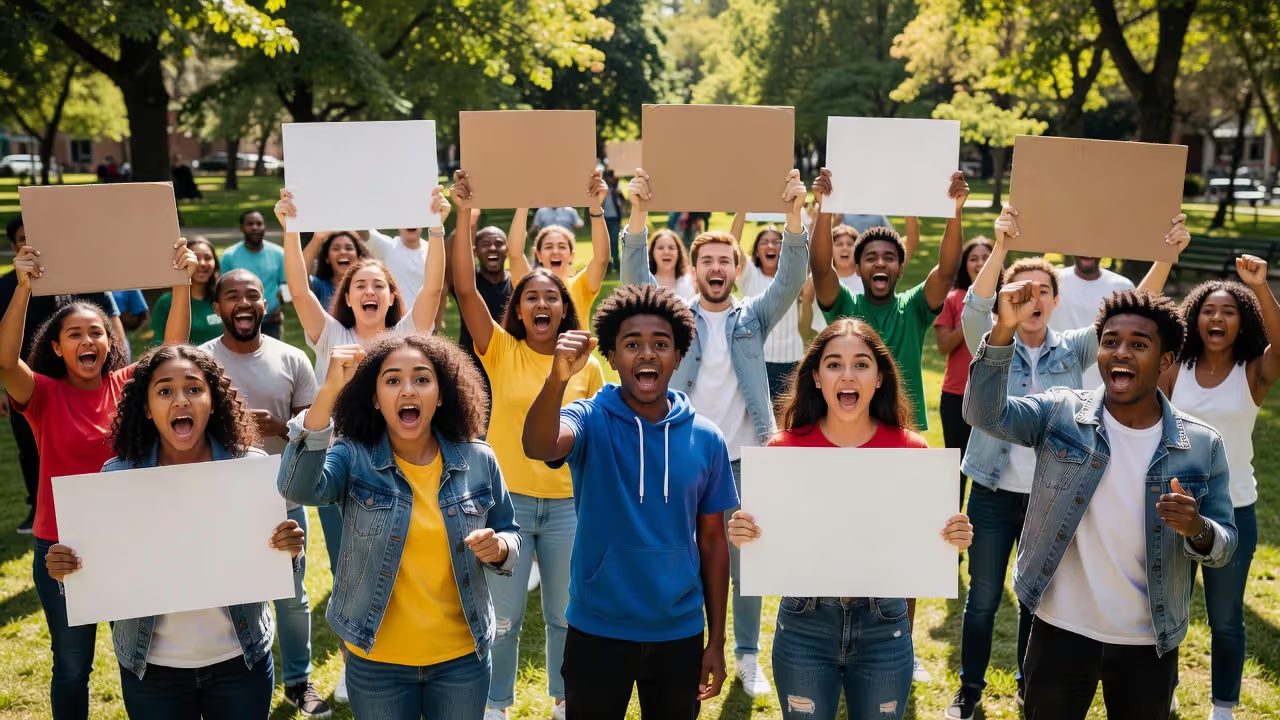
The benefits of social media for youth in civic life are concrete. The March for Our Lives movement in 2018 was organized largely through social platforms by teenagers. Climate activism, racial justice organizing, and voter registration drives among young people have all been amplified through social media in ways that traditional civic education never managed to achieve.
Social media benefits for young people extend to simple awareness. A teenager who follows journalists, policy advocates, and community organizers on Twitter or Instagram is getting a civic education that goes well beyond what most schools provide. They're seeing how issues develop in real time. They're learning to evaluate sources — sometimes the hard way, but they're learning.
Youth voter turnout has climbed steadily, and researchers consistently point to social media as one of the key drivers. When a cause or candidate goes viral among young people, the downstream effect on registration and turnout is measurable.
Author: Olivia Brackenridge;
Source: colorfulpagescoalition.org
What Healthy Social Media Use for Teens Actually Looks Like
Healthy social media use for teens isn't about hitting a specific daily minute count. It's about habits, context, and emotional outcomes.
The American Academy of Pediatrics recommends that families develop a personalized media plan rather than applying a rigid one-size-fits-all screen time limit. That's actually good advice. A teen who spends two hours a day creating music on social platforms is in a very different situation from one who spends two hours passively scrolling comparison content.
How social media helps teens in the long run depends heavily on the habits built early. Teens who learn to curate their feeds — following accounts that inspire or educate rather than those that trigger envy — tend to have better experiences. Parents who stay involved without being controlling make a real difference. And platform choice matters: a teen using Pinterest to build a design portfolio has a fundamentally different experience than one using an anonymous platform with no moderation.
Practical Habits That Support Balanced Use
A few habits consistently show up in research as protective factors for teens using social media:
Setting a consistent "off" time at night — ideally at least an hour before sleep — has a direct impact on sleep quality. Screens before bed suppress melatonin, and sleep deprivation amplifies almost every mental health risk factor in adolescence.
Keeping phones out of bedrooms entirely is even more effective, though harder to enforce with older teens. The compromise many families land on: chargers stay in common areas.
Periodically auditing who you follow is something most adults don't do either, but it's genuinely useful. If an account consistently makes a teen feel bad about themselves, unfollowing it isn't weakness — it's curation.
| Category | Healthy Use | Unhealthy Use |
| Daily Screen Time | Purposeful, time-limited sessions | Uncontrolled, hours lost without awareness |
| Content Type | Educational, creative, community-building | Comparison-heavy, rage-bait, passive scrolling |
| Emotional Response | Inspired, connected, energized | Anxious, envious, empty after use |
| Social Interaction Quality | Meaningful exchanges, real relationships | Performative, seeking validation only |
| Sleep Impact | Devices off 1+ hour before bed | Scrolling until falling asleep, disrupted rest |

Author: Olivia Brackenridge;
Source: colorfulpagescoalition.org
FAQ: Social Media and Youth Questions Answered
Social media isn't going away, and the goal was never to eliminate it from young people's lives. The more realistic and useful goal is helping teens use it in ways that actually serve them — building connections, developing skills, engaging with the world, and expressing who they are. That's achievable. And it starts with understanding what's genuinely possible when use is thoughtful rather than just habitual.
Related Stories

Read more

Read more



The content on this website is provided for general informational and educational purposes only. It is intended to explain concepts related to parenting, child development, family caregiving, adoption, fostering, and child safety.
All information on this website, including articles, guides, and examples, is presented for general educational purposes. Outcomes may vary depending on individual family circumstances.
This website does not provide professional medical, psychological, or legal advice, and the information presented should not be used as a substitute for consultation with qualified pediatricians, child psychologists, or family counselors.
The website and its authors are not responsible for any errors or omissions, or for any outcomes resulting from decisions made based on the information provided on this website.