

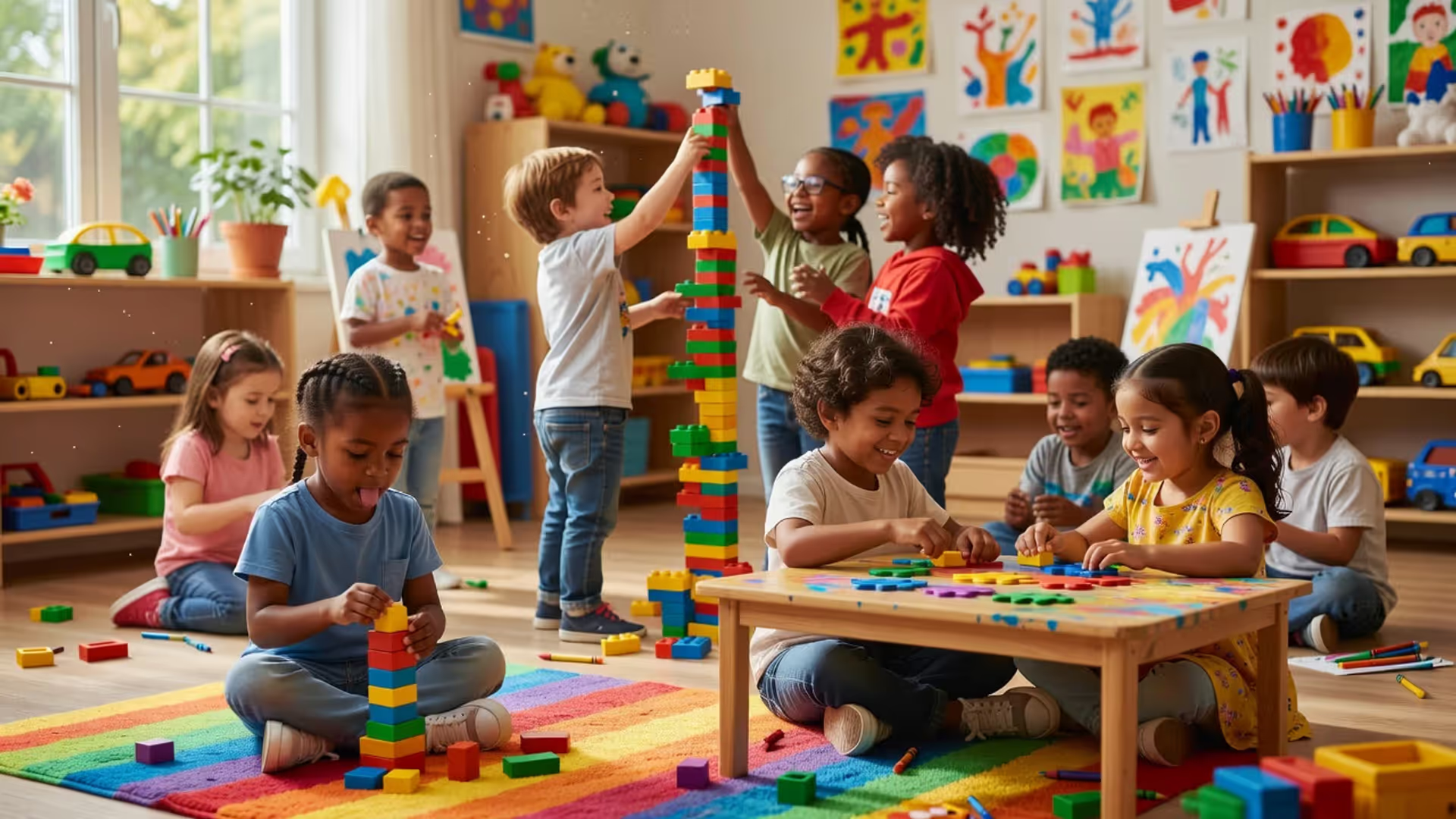
Children at different stages of childhood development with caregivers
What Is Childhood and How It Is Defined?

Childhood is one of those concepts that feels obvious until you try to explain it. Everyone has lived through it. But defining it precisely — where it starts, where it ends, and what it actually means — turns out to be more complicated than most people expect. The answer shifts depending on whether you're asking a doctor, a lawyer, a historian, or a parent.
Childhood Definition Across Different Contexts
At its most basic, the childhood definition refers to the period of human life between birth and the onset of adulthood. But that phrasing immediately raises a question: when does adulthood begin? And the honest answer is that it depends on who you ask.
The meaning of childhood isn't fixed. It changes based on the framework you're using. Biologically, it's tied to physical development and brain maturation. Legally, it's defined by age thresholds written into law. Culturally, it reflects the values, expectations, and economic conditions of a given society. So what is childhood, really? It's all three of these things at once — and none of them alone tells the full story.
Legal Age Boundaries in the United States
In the US, the legal definition of childhood is tied primarily to the concept of minority. A person is legally a child — or a minor — until they turn 18. At that point, they gain the right to vote, sign contracts, and make independent legal decisions. But even this isn't perfectly consistent. You can join the military at 17 with parental consent. You can't buy alcohol until 21. The legal picture is layered.
Federal law also uses specific age thresholds for child protection. The Child Abuse Prevention and Treatment Act (CAPTA) defines a child as anyone under 18. The Family Educational Rights and Privacy Act (FERPA) extends certain protections to students regardless of age, but its roots are in protecting minors. So legally, 18 is the dominant cutoff — though specific statutes carve out exceptions depending on context.
How Medical and Developmental Science Defines Childhood
Medicine draws the line differently. Pediatricians in the US typically treat patients up to age 18, but the American Academy of Pediatrics has recommended extending care through age 21 in many cases — particularly for adolescents with chronic conditions. Brain development research complicates things even further. The prefrontal cortex, which governs decision-making and impulse control, doesn't fully mature until the mid-20s.
So from a neuroscience standpoint, "childhood" in the sense of developmental immaturity extends well past what the law recognizes. That's not a contradiction — it's just two different frameworks answering two different questions.
The Main Stages of Childhood by Age Group
Most developmental frameworks break childhood into distinct phases. The stages of childhood aren't arbitrary — they reflect real shifts in how children grow, think, and interact with the world. Here's a structured look at the main phases of childhood:
| Stage Name | Approximate Age Range | Key Developmental Focus |
| Prenatal / Newborn | Birth – 1 month | Basic reflexes, sensory response, bonding |
| Infancy | 1 month – 12 months | Motor skills, attachment, early language |
| Toddlerhood | 1 – 3 years | Walking, talking, autonomy, parallel play |
| Early Childhood | 3 – 6 years | Language explosion, imaginative play, pre-literacy |
| Middle Childhood | 6 – 11 years | Logical thinking, academic skills, peer relationships |
| Late Childhood / Preadolescence | 11 – 13 years | Abstract reasoning begins, identity formation starts |
These aren't rigid cutoffs. A child at 5 years and 11 months isn't fundamentally different from one who just turned 6. But the groupings reflect patterns that researchers have observed consistently across large populations.

Author: Rebecca Thornfield;
Source: colorfulpagescoalition.org
What Developmental Milestones Mark Each Phase
Milestones are the observable markers — the things a child can typically do at a given age that signal healthy development. They span four broad domains: physical, cognitive, language, and social-emotional.
In infancy, milestones include tracking objects with the eyes, responding to voices, and eventually pulling to stand. By toddlerhood, most children are walking independently and saying their first words. Early childhood brings a surge in vocabulary — children can gain 5 to 10 new words per day between ages 2 and 5. That's a rate of acquisition that adults simply can't match.
Middle childhood is when child development becomes more visible in structured settings like school. Children develop the ability to read, solve multi-step math problems, and form lasting friendships. They also start comparing themselves to peers — which can be a source of both motivation and anxiety.
The pattern I see most often in developmental literature is that cognitive milestones tend to get the most attention, while social-emotional development gets underemphasized. That's a mistake. A child who can read at 5 but can't regulate frustration at 8 is going to face real challenges.
One counterintuitive point: missing a milestone by a few weeks or months doesn't automatically signal a problem. Developmental ranges are wide. What matters more is the overall trajectory over time.

Author: Rebecca Thornfield;
Source: colorfulpagescoalition.org
How Culture and History Have Shaped the Meaning of Childhood
The idea that childhood is a protected, carefree phase of life is relatively recent. For most of human history, children were treated as small adults — expected to work, contribute economically, and take on adult responsibilities as soon as they were physically capable. In medieval Europe, children as young as 7 were apprenticed into trades or sent to work in fields.
The modern concept of childhood as a distinct developmental phase emerged gradually, accelerating in the 19th and early 20th centuries. Child labor laws in the US — particularly the Fair Labor Standards Act of 1938 — were a turning point. They legally separated childhood from adult economic life for the first time on a broad scale.
What defines childhood has also varied sharply across cultures. In some societies, puberty marks the transition to adulthood through formal ceremony. In others, marriage or military service sets the boundary. Even today, the United Nations Convention on the Rights of the Child (1989) defines a child as anyone under 18 — but not every country has ratified it or applies it uniformly.
History makes one thing clear: childhood as we understand it isn't a biological inevitability. It's a social construction that reflects the values and economic conditions of the society that defines it.

Author: Rebecca Thornfield;
Source: colorfulpagescoalition.org
What Defines Childhood Beyond Age
Age is the most convenient marker, but it's not the whole picture. The childhood definition gets richer — and more accurate — when you factor in the social and psychological dimensions.
Environment shapes childhood profoundly. A child growing up in a stable, resource-rich household experiences a fundamentally different developmental trajectory than one raised in poverty or instability. Access to education, healthcare, safe housing, and consistent caregiving all influence how childhood unfolds. These aren't soft variables — they have measurable effects on brain development, stress hormone levels, and long-term outcomes.
The capacity to love is the most important thing a parent can give a child. But the ecology of human development — the nested systems of family, school, community, and culture — shapes whether that love can take root and grow.
— Bronfenbrenner Urie
Psychological safety matters just as much as physical safety. Children need predictable relationships with caregivers to develop secure attachment — a foundation that influences emotional regulation and social functioning well into adulthood. A childhood that's technically "safe" in the physical sense but emotionally chaotic still carries developmental risk.
So what defines childhood beyond age? It's the presence — or absence — of the conditions that allow healthy development to happen. Age sets the timeline. Everything else determines the quality of the experience.
Common Misconceptions About Childhood Explained
A few misunderstandings about childhood show up repeatedly — and they're worth clearing up.
Misconception 1: Childhood ends at 18. Legally, yes. Developmentally, no. Brain maturation continues into the mid-20s. Treating 18-year-olds as fully formed adults in every context ignores what neuroscience actually shows.
Misconception 2: Children are resilient, so early hardship doesn't matter much. This one is genuinely harmful. Children are adaptable, but that's different from being unaffected. Adverse childhood experiences (ACEs) — a category that includes abuse, neglect, and household instability — are linked to higher rates of chronic disease, mental health disorders, and substance use in adulthood. The research on this is extensive and consistent.
Misconception 3: All children develop at the same pace. Developmental ranges exist for a reason. There's a wide band of "normal," and children hit milestones at different times. Comparing one child's progress to another's at a fixed age is often more anxiety-producing than useful.
Misconception 4: Childhood was better in the past. This is nostalgia talking. Child mortality rates were dramatically higher. Child labor was common. Access to education was limited, especially for girls and minority children. By nearly every measurable standard, childhood outcomes in the US have improved over the past century — though serious inequities remain.

Author: Rebecca Thornfield;
Source: colorfulpagescoalition.org
FAQ: Childhood Definition and Development Questions Answered
Childhood is a concept that seems simple on the surface but carries real complexity underneath. It's a legal category, a biological process, a cultural construction, and a lived experience — all at once. Understanding what shapes it, and what can disrupt it, matters far beyond academic interest. The conditions children grow up in have consequences that last a lifetime.
Related Stories
Read more

Read more




The content on this website is provided for general informational and educational purposes only. It is intended to explain concepts related to parenting, child development, family caregiving, adoption, fostering, and child safety.
All information on this website, including articles, guides, and examples, is presented for general educational purposes. Outcomes may vary depending on individual family circumstances.
This website does not provide professional medical, psychological, or legal advice, and the information presented should not be used as a substitute for consultation with qualified pediatricians, child psychologists, or family counselors.
The website and its authors are not responsible for any errors or omissions, or for any outcomes resulting from decisions made based on the information provided on this website.