
What Is Considered Harassment by a Co Parent
What Is Considered Harassment by a Co Parent?

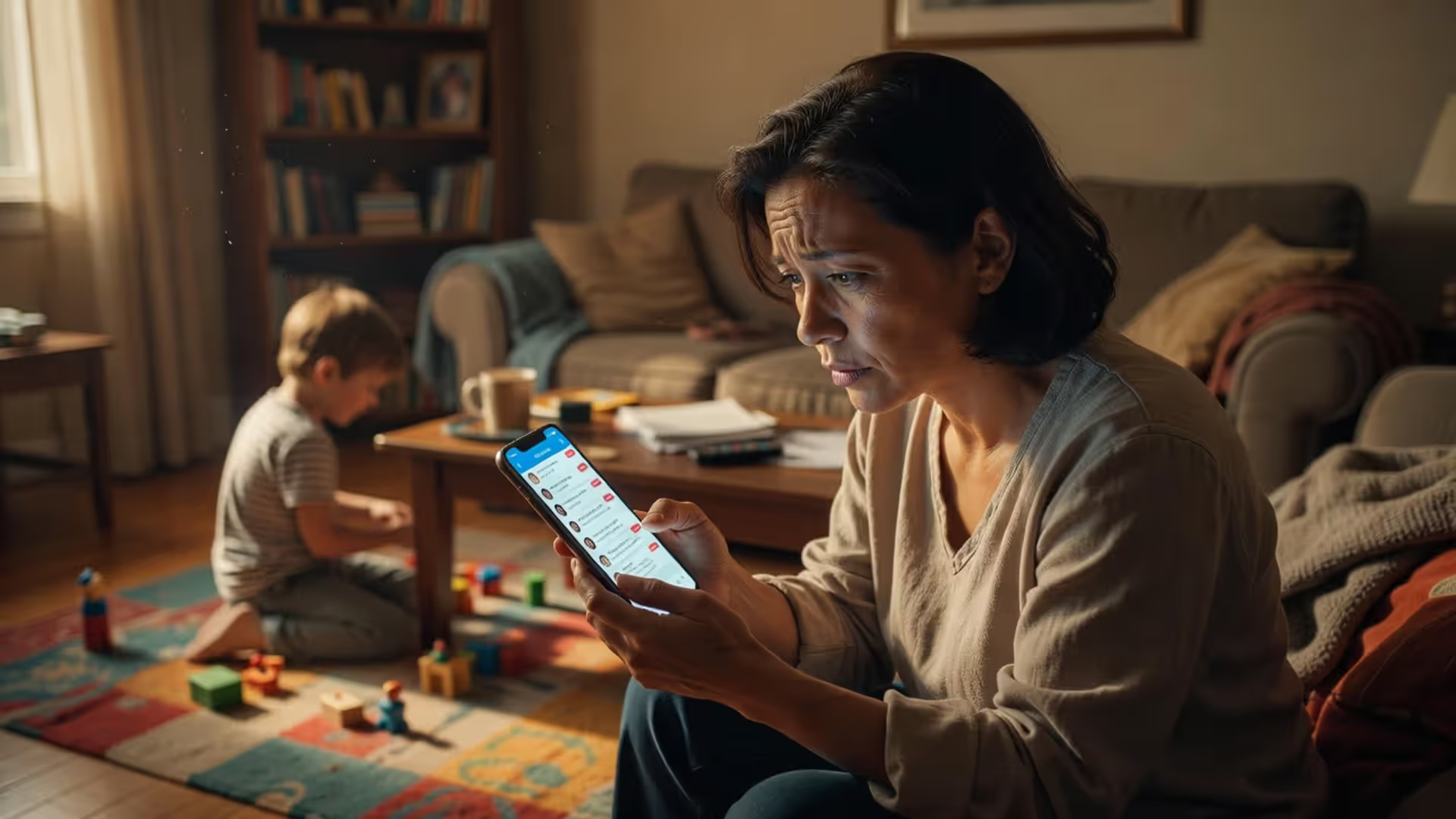
Co-parenting is hard enough when both people are trying. But when one parent starts using contact, the kids, or daily logistics as weapons — that's a different situation entirely. Knowing what is considered harassment by a co parent matters, because the line between "frustrating" and "legally actionable" isn't always obvious. And crossing it has real consequences.
How Co-Parent Harassment Differs from Normal Conflict
Every co-parenting relationship has friction. Disagreements over school schedules, arguments about holiday plans, the occasional heated text — none of that is automatically harassment. Co-parent harassment is a pattern, not a single bad moment.
Normal conflict looks like two people who can't agree but are still trying. Harassment looks like one person using repeated, targeted behavior to intimidate, control, or destabilize the other. The difference is intent and frequency.
Here's a concrete example. If your co-parent texts you twice in one day asking about a doctor's appointment, that's communication. If they text you 40 times in a day, call your employer, and show up uninvited at your home — that's a pattern courts take seriously.
Co parenting boundaries get tested constantly. But when one parent refuses to respect any limit, no matter how clearly it's communicated, you're likely dealing with something more than normal conflict. The pattern I see most often is a gradual escalation — what starts as one extra call a week becomes daily calls, then hourly messages, then threats.
Common Forms of Co-Parent Harassment
Co-parent harassment doesn't always look dramatic. Some of it is subtle. Some of it is relentless. Here are the main behavioral patterns.

Author: Rebecca Thornfield;
Source: colorfulpagescoalition.org
Excessive and unwanted contact — calling or texting far beyond what's needed for child coordination, especially late at night or during work hours.
Threats and intimidation — threatening to take the children, threatening legal action repeatedly as a scare tactic, or making veiled threats about financial support.
Public humiliation — posting about you on social media, contacting your family members or coworkers to spread negative information, or making false reports to schools or child protective services.
Interference with parenting time — showing up unannounced during your parenting days, pressuring the children to report back, or deliberately scheduling activities that conflict with your custody time.
| Behavior Type | Normal Conflict Example | Harassment Example | Potential Legal Consequence |
| Communication frequency | 2–3 texts about pickup logistics | 30+ messages daily, including late-night calls | Basis for restraining order or custody modification |
| Showing up unannounced | Arriving 10 minutes early for pickup | Repeatedly appearing at your home or workplace | Violation of parenting plan, possible trespass |
| Social media activity | Posting a photo of the child | Publishing false accusations about you publicly | Defamation claim, court-ordered removal |
| Using the child | Child accidentally relays a message | Parent instructs child to spy or deliver threats | Parental alienation finding, custody impact |
| False reports | Raising genuine safety concerns | Filing repeated unfounded CPS complaints | Sanctions, attorney's fees, custody review |
| Financial threats | Disputes over support amounts | Threatening to withhold support to coerce behavior | Contempt of court, enforcement action |
Digital Harassment and Unwanted Contact
Text messages and emails have become the primary battlefield in co-parent harassment cases. And that's actually useful for documentation purposes — but more on that later.
Digital harassment includes sending hostile or threatening messages, contacting you through social media after being blocked, creating fake accounts to monitor or contact you, and emailing you at work to cause professional disruption. Some co-parents use shared apps or school portals to continue harassment under the guise of "co-parenting communication."
One thing courts look at closely is volume. A hundred texts in a week about a single non-urgent issue isn't coordination. It's pressure.
Using the Children as Messengers or Weapons
This one's particularly damaging — both legally and emotionally. When a co-parent uses the children to deliver messages, gather information, or relay threats, it pulls kids into adult conflict they shouldn't be anywhere near.
Toxic co parenting signs often include a child who comes home anxious, repeating things they clearly didn't come up with themselves, or feeling like they have to "report" on the other parent's household. That's not a parenting style. That's a child being used as a tool.
Courts treat this seriously. A judge who sees evidence of a parent weaponizing the children will factor that into custody decisions.
Recognizing the Signs of Co-Parenting Harassment
Sometimes you're too close to the situation to see it clearly. Here's a practical way to assess what you're experiencing.
Signs of co parenting harassment include:
- You feel afraid or anxious before every scheduled communication
- Messages arrive at all hours, regardless of urgency
- Your co-parent contacts people in your personal or professional life
- You've set clear limits and they're repeatedly ignored
- Your child comes home distressed, scared, or repeating adult phrases
- You've received threats — even indirect ones — about custody, money, or your reputation
- Your co-parent files repeated complaints with schools, courts, or agencies that go nowhere

Author: Rebecca Thornfield;
Source: colorfulpagescoalition.org
One counterintuitive point: not all harassment is loud. Some of it looks like excessive "concern" — constant check-ins framed as caring about the child, repeated requests for information that go beyond what's needed, or showing up "just to drop something off." The intent matters as much as the action.
Toxic co parenting signs don't always come with shouting. Sometimes they come with a smile.
Legal Standards for Co-Parent Harassment in the US
What the law considers harassment varies by state, but there are common threads. Most states define harassment as a course of conduct — meaning repeated behavior, not a single incident — that causes a reasonable person to feel alarmed, threatened, or substantially distressed.
In family law contexts, civil harassment restraining orders are one of the primary tools available. These orders can restrict contact, limit communication to specific platforms, and require a co-parent to stay away from your home or workplace. Violating a restraining order is a criminal offense in every US state.
Courts also look at whether behavior rises to the level of stalking, cyberstalking, or criminal harassment — all of which carry separate criminal penalties beyond family court jurisdiction.
Documentation is everything here. Courts don't act on feelings; they act on evidence. Screenshots, call logs, voicemails, and records of incidents (with dates and times) are what turn a story into a case.

Author: Rebecca Thornfield;
Source: colorfulpagescoalition.org
Some states — California, Texas, New York, and Florida among them — have specific family code provisions addressing harassment between co-parents. Others handle it through general harassment or stalking statutes. An attorney licensed in your state can tell you exactly which standard applies to your situation.
How to Respond When a Co-Parent Crosses the Line
Don't panic. Don't retaliate. Document everything.
That's the short version. Here's the longer one.
Start a log immediately. Every incident, every message, every unannounced visit. Date, time, what happened, who witnessed it. Even if you never go to court, this log protects you.
Switch to a documented communication platform. Apps like TalkingParents or OurFamilyWizard create timestamped, uneditable records of every message. Courts love these. They remove the "he said, she said" problem almost entirely.
Don't engage with bait. Dealing with a difficult co parent often means resisting the urge to respond to provocative messages. Responding to harassment can escalate it — and it muddies your record. Keep your responses brief, factual, and child-focused.
Talk to a family law attorney. Even one consultation can clarify your options. If the harassment is severe, an attorney can help you file for a protective order or request a custody modification based on the other parent's conduct.
Involve a mediator if appropriate. In some cases — particularly where harassment hasn't yet reached criminal levels — a court-appointed mediator or parenting coordinator can help establish and enforce co-parenting boundaries. This is often faster and cheaper than litigation.
The simpler option usually wins here: document first, act second.
Setting Boundaries That Hold Up in Court

Author: Rebecca Thornfield;
Source: colorfulpagescoalition.org
A boundary you can't enforce isn't really a boundary. Co parenting boundaries need to be written into your parenting plan to carry legal weight.
Effective parenting plan clauses include:
- Designated communication windows (e.g., 8 a.m. to 8 p.m. only)
- Required use of a specific communication platform
- No third-party contact (meaning your co-parent can't contact your family, employer, or new partner)
- Defined pickup and drop-off procedures that eliminate unnecessary interaction
- Clear consequences for violations, including the right to seek court enforcement
Co parent communication issues often stem from vague parenting plans. The more specific your plan, the less room there is for manipulation.
If your current parenting plan doesn't include these provisions, you can petition the court to modify it. Judges are generally receptive to adding communication restrictions when there's documented evidence of harassment or co parent communication issues that harm the child's stability.
And here's what a real family law expert says about the stakes involved:
When one parent persistently undermines the other through harassment, intimidation, or using the children as pawns, the damage extends far beyond the adults involved. Courts increasingly recognize that a parent's conduct toward their co-parent is direct evidence of their fitness as a parent — because children absorb every bit of that conflict.
— Wallerstein Judith
That framing — a parent's conduct toward their co-parent as evidence of parenting fitness — is exactly how many family court judges think about these cases now.
FAQ: Co-Parent Harassment Questions Answered
If you're experiencing what feels like harassment from a co-parent, trust that instinct enough to start documenting. You don't need a lawyer to open a notes app and start keeping records. What you do need is clarity about what's happening, and the steps above give you a real starting point. Your stability — and your child's — depends on taking this seriously before it escalates further.
Related Stories

Read more
Read more




The content on this website is provided for general informational and educational purposes only. It is intended to explain concepts related to parenting, child development, family caregiving, adoption, fostering, and child safety.
All information on this website, including articles, guides, and examples, is presented for general educational purposes. Outcomes may vary depending on individual family circumstances.
This website does not provide professional medical, psychological, or legal advice, and the information presented should not be used as a substitute for consultation with qualified pediatricians, child psychologists, or family counselors.
The website and its authors are not responsible for any errors or omissions, or for any outcomes resulting from decisions made based on the information provided on this website.