
What Is Open Adoption and How It Works
What Is Open Adoption and How It Works?

Content
Content
Choosing how to build your family through adoption is one of the most personal decisions you'll ever make. And one of the first questions most people face is: what kind of adoption arrangement actually fits your life? Open adoption has become the most common arrangement in the US, but it's also one of the most misunderstood. Some people picture awkward holiday dinners with strangers. Others worry about legal complications or confused kids. The reality is much more nuanced — and for many families, open adoption turns out to be the most workable path forward.
Types of Adoption Arrangements in the US
Adoption in the US doesn't follow a single template. It spans a wide spectrum, and the arrangement you choose shapes everything from the initial paperwork to the relationships your child carries into adulthood. Three main categories define that spectrum.
Open Adoption
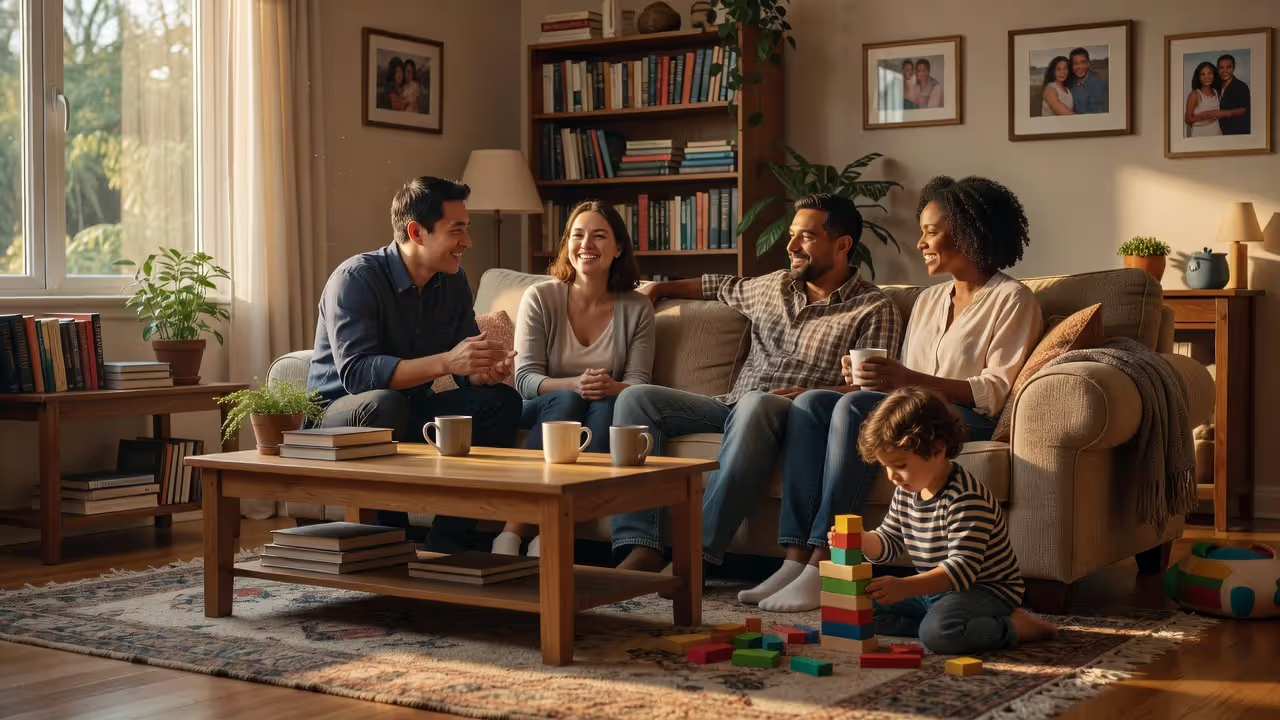
Open adoption is an arrangement where the adoptive family and the birth family maintain real, ongoing contact after placement. That contact can look very different from one family to the next — some families share birthday visits and holiday cards, while others keep things to a few video calls per year. The specifics get worked out in a contact agreement before placement, so both sides know what to expect.
This model now dominates domestic infant adoption in the US. Adoption researchers and practitioners shifted toward openness over the past few decades as longitudinal studies began showing better developmental outcomes for children who stayed connected to their biological origins. It wasn't a sudden change — it was a gradual, evidence-driven evolution in how the field understood what children actually need.
Semi-Open Adoption
Semi-open adoption occupies the middle ground. Contact still happens, but it flows through a third party — usually the adoption agency — rather than directly between families. A birth mother might receive a letter and photos twice a year without ever knowing the adoptive family's last name or address. The adoptive family might get occasional health updates without having a direct phone number to call.
This structure appeals to families who want some connection but aren't comfortable with fully direct communication, at least not yet. It's also worth noting that semi-open arrangements aren't always permanent. As trust develops and comfort grows, many families gradually move toward more direct contact over time.
Closed Adoption
In a closed adoption, no identifying information is exchanged and no contact occurs after placement. Birth records are sealed, and the child grows up without direct knowledge of their biological background unless they pursue that information independently — through DNA testing services, for instance, or a court petition to unseal records.
Closed adoption was the default model in the US for most of the 20th century. Today it's relatively rare in domestic infant adoption, though it still appears in certain international adoption contexts and in cases where safety concerns make any contact inappropriate.
Author: Rebecca Thornfield;
Source: colorfulpagescoalition.org
Open vs Closed Adoption: Key Differences
Choosing between these two arrangements has real, lasting consequences for the child — not just emotionally, but in terms of practical access to information that affects their life. The table below lays out where the two models diverge most sharply.
| What's Being Compared | Open Adoption | Closed Adoption |
| Ongoing contact with birth family | Structured and direct, based on a negotiated schedule | No contact of any kind following placement |
| Birth record accessibility | Generally available to the child; state laws vary | Frequently sealed; may require legal action to access |
| Biological identity information | Introduced to the child early and openly | Often unavailable until adulthood, if accessible at all |
| Whether contact terms are legally enforceable | State-dependent; approximately 30 or more states offer some enforcement mechanism | Irrelevant — there are no contact terms to enforce |
| Where this arrangement is most common today | Standard practice in domestic infant adoption | Primarily seen in certain international adoptions or safety-driven situations |
Something that surprises many people new to this process: open adoption has no effect on legal parenthood. The moment an adoption is finalized, the adoptive parents hold full parental rights. A contact agreement governs the relationship between families — it has nothing to do with custody, decision-making authority, or who raises the child. Those questions are settled permanently at finalization.
How Open Adoption Works Step by Step
The mechanics of open adoption are more straightforward than most people expect, but the process does require deliberate communication at each stage.
It typically begins with a match. Prospective adoptive families put together a profile — sometimes called a family letter or home study profile — that expectant parents review when selecting an adoptive family. In open adoption specifically, many birth parents look for explicit signals that the family is genuinely committed to staying in contact, not just willing to tolerate it.
Once a match is established, both families usually meet before the birth or placement takes place. These early conversations are where the real work happens: what does each side actually want? Weekly texts or annual visits? Video calls with grandparents included, or just the immediate families? The answers to these questions get formalized in the contact agreement.

Author: Rebecca Thornfield;
Source: colorfulpagescoalition.org
Placement follows after the birth parent or parents sign relinquishment documents — a timeline that varies by state but most commonly falls within 24 to 72 hours after birth. Legal finalization of the adoption typically comes 6 to 12 months later, after a court hearing confirms everything is in order.
What a Contact Agreement Covers
A post-adoption contact agreement — often abbreviated as a PACA — is the written document that defines the ongoing relationship between families. A well-drafted agreement typically addresses:
- How often contact occurs: the number of visits, calls, or written exchanges per year
- What form contact takes: in-person meetings, video calls, mailed letters, shared photo apps, or some mix
- Who participates: whether the agreement extends to birth siblings, grandparents, or other relatives
- A process for handling disagreements: what both parties agree to do if one side wants to revise the terms
Legal enforceability is where things get complicated. Roughly 30 states currently have statutes that give these agreements some form of legal standing. But even in those states, enforcing a contact agreement through the courts is a slow, expensive, and emotionally draining process. Most adoption professionals encourage families to approach these agreements as genuine commitments — not as legal leverage — and to invest in the relationship itself rather than relying on enforcement mechanisms. Families who build real trust early on rarely end up in court over contact disputes.
Benefits of Open Adoption for All Parties
Open adoption often gets framed as something birth parents accept reluctantly and adoptive parents tolerate. The longitudinal research tells a more interesting story.
For the child, the clearest and most consistently documented benefit involves identity. A child who grows up knowing their birth family doesn't have to piece together who they are from medical records and guesswork. They know their biological history. They can ask questions and get real answers. Research from the Minnesota/Texas Adoption Research Project — one of the longest-running studies of its kind — found that children in open arrangements showed no greater adjustment difficulties than those in closed ones, and often demonstrated a stronger, more grounded sense of self.
For birth parents, open adoption tends to ease grief rather than intensify it. The same longitudinal studies found that birth mothers who maintained some form of contact reported greater peace with their decision over time, compared to those in closed arrangements. Knowing that the child is doing well — seeing a photo, hearing about a school milestone — makes a concrete difference in how birth parents process their experience.
For adoptive parents, the practical advantages are significant. Families gain ongoing access to the child's biological health history, which can matter enormously if a medical issue surfaces years later. They can respond to their child's questions about origins with actual information rather than uncertainty. And perhaps most meaningfully, they don't have to dread the moment their teenager decides to search for their birth family — because that relationship is already woven into the family's story from the beginning.

Author: Rebecca Thornfield;
Source: colorfulpagescoalition.org
Common Concerns About Open Adoption
The anxieties people bring to open adoption are legitimate. Brushing them aside doesn't help anyone. What actually helps is looking at what the evidence shows.
"Will the child be confused about who their parents really are?" This concern comes up constantly, and it makes intuitive sense — but it isn't supported by the research. Children are far more capable of holding multiple relationships in their minds than adults tend to give them credit for. A child who visits their birth mother twice a year still knows, without any ambiguity, who makes their doctor's appointments, reads them bedtime stories, and shows up at every school event. Contact with birth family adds complexity to a child's world; it doesn't scramble their understanding of who their parents are.

Author: Rebecca Thornfield;
Source: colorfulpagescoalition.org
"What happens if the birth parent pushes past agreed boundaries?" This does occur in some cases. It's not the typical experience, but it happens — and it's a valid concern. That's precisely why working with an experienced adoption attorney to draft a clear, detailed contact agreement matters so much. When situations change or someone oversteps, agreements can be renegotiated. Contact can be reduced, restructured, or temporarily paused when circumstances genuinely require it. Choosing open adoption doesn't mean surrendering the ability to set and maintain boundaries.
"What if we simply don't connect with the birth family?" Not every match produces a warm relationship, and that's okay. Open adoption doesn't require closeness — it requires follow-through and good faith. An annual exchange of photos and a brief written update still counts. Even minimal, consistent contact can matter to a child who grows up knowing their birth family cared enough to stay in touch.
One pattern worth naming directly: some adoptive parents over-commit to contact during the matching process — promising frequent visits or close involvement — and then pull back significantly after finalization. This is one of the most damaging things that can happen in an open adoption. It erodes trust with the birth family and, more importantly, it sends the child a confusing message about reliability. Whatever level of contact you agree to, make sure it reflects what you can genuinely sustain over years, not what sounds appealing in the moment.
Secrecy and shame have no place in modern adoption. Children deserve to know who they are and where they come from — and the evidence shows that honesty, far from being harmful, is the foundation of healthy development for adoptees.
— Pertman Adam
FAQ: Open Adoption Questions Answered
Adoption is never a one-size-fits-all decision, and the right arrangement depends on your specific circumstances, your comfort level, and what the child in front of you actually needs. What decades of research and real-world experience make increasingly clear is that open adoption — approached with honesty, realistic expectations, and genuine commitment — tends to give children more to work with, not less. More information about where they came from. A stronger foundation for understanding who they are. And more people invested in their wellbeing. That's worth understanding clearly before you decide.
Related Stories
Read more
Read more



The content on this website is provided for general informational and educational purposes only. It is intended to explain concepts related to parenting, child development, family caregiving, adoption, fostering, and child safety.
All information on this website, including articles, guides, and examples, is presented for general educational purposes. Outcomes may vary depending on individual family circumstances.
This website does not provide professional medical, psychological, or legal advice, and the information presented should not be used as a substitute for consultation with qualified pediatricians, child psychologists, or family counselors.
The website and its authors are not responsible for any errors or omissions, or for any outcomes resulting from decisions made based on the information provided on this website.