

What Is the International Adoption Definition and How It Works
What Is the International Adoption Definition and How It Works?

Adopting a child from another country is one of the most life-changing decisions a family can make. It's also one of the most legally complex. Before you start filling out paperwork or contacting agencies, you need a clear picture of what international adoption actually means, how the process works, and what you're genuinely signing up for. This guide breaks it all down in plain terms.
International Adoption Explained in Plain Terms
So, what is international adoption? At its core, it's when a citizen of one country legally adopts a child who is a citizen of another country. The child then typically immigrates to the adoptive parents' home country and becomes a permanent legal member of their family.
International adoption basics differ from domestic adoption in a few key ways. With domestic adoption, you're working within one country's legal system. With international adoption, you're navigating two countries' laws simultaneously — your own and the child's birth country. That means more agencies, more paperwork, more government oversight, and longer timelines.
A common misconception is that international adoption is simply "buying" a child from a poorer country. That's wrong. Every legitimate international adoption must comply with strict child welfare standards, verify that the child is legally eligible for adoption, and confirm that no viable domestic placement exists in the birth country first. The child's best interest drives the process — not the adoptive parents' preferences.
Another thing people get wrong: international adoption isn't faster than domestic adoption. In many cases, it takes longer. Country-specific backlogs, changing immigration policies, and documentation requirements can stretch the process out by years.
Intercountry Adoption Meaning Under US Law
Under US law, "intercountry adoption" and "international adoption" are used interchangeably, but "intercountry" is the formal legal term. The US government defines an intercountry adoption as the adoption of a foreign national child by a US citizen, where the child then immigrates to the United States to live permanently with their new family.
The legal framework governing this process in the US comes from two main sources: the Immigration and Nationality Act (INA) and the Intercountry Adoption Act of 2000, which implemented the Hague Convention on Intercountry Adoption into US domestic law. Together, these statutes define who can adopt, which children are eligible, and what steps must be followed.
The US Department of State and US Citizenship and Immigration Services (USCIS) are the two federal agencies most involved. The State Department manages the international side — country programs, visa issuance, and treaty compliance. USCIS handles the domestic immigration approval side, including the I-800A or I-600A petition depending on whether the child's birth country is a Hague country.
Hague Convention Countries vs. Non-Hague Countries
The Hague Convention on Intercountry Adoption is an international treaty that sets minimum standards for intercountry adoptions. As of 2026, over 100 countries have signed it. The US ratified it in 2008.
Not every country the US processes adoptions from is a Hague signatory. This matters a lot for how the adoption is handled. Here's a direct comparison:
| Feature | Hague Convention Countries | Non-Hague Countries |
| Legal framework | Hague Convention + Intercountry Adoption Act of 2000 | Immigration and Nationality Act (INA) only |
| Required agencies | Must use Hague-accredited US adoption service provider | Accredited or approved provider, or supervised provider |
| Processing oversight | Dual oversight: US + foreign Central Authority | Less standardized; varies by country |
| Example countries | China, India, Colombia, South Korea | Ethiopia (closed), Russia (closed), Marshall Islands |
| Average timeline | 2–5 years | 1–4 years (highly variable) |
The Hague Convention transformed intercountry adoption by creating a framework that prioritizes child welfare over expediency. It requires that children are legally free for adoption, that birth parents haven't been coerced, and that adoptive parents are genuinely qualified — standards that didn't exist uniformly before the treaty.
— McDermott Mark T.
How International Adoption Works Step by Step
Understanding how international adoption works means following a multi-stage process that spans two countries. Here's the full picture.
Step 1 — Determine eligibility. Before anything else, you need to confirm you meet both US requirements and the requirements of your target country. Age minimums, marital status rules, and income thresholds vary by country.
Step 2 — Choose a country. This isn't just about preference. You need to research which countries are currently open to US adoptive parents, what their specific requirements are, and how long their programs are taking. Some countries have suspended programs entirely.
Step 3 — Select an adoption service provider. For Hague countries, this must be an accredited agency. You can't self-represent.
Step 4 — Complete a home study. A licensed social worker evaluates your home, your finances, your background, and your readiness to parent. This report is required by both the US government and the child's birth country.
Step 5 — File with USCIS. You submit either Form I-800A (Hague) or Form I-600A (non-Hague) to get pre-approved to adopt internationally. USCIS reviews your home study and criminal background.

Author: Rebecca Thornfield;
Source: colorfulpagescoalition.org
Step 6 — Get matched with a child. The birth country's Central Authority or court identifies a child who is legally eligible for intercountry adoption and matches them with your family.
Step 7 — Travel to the birth country. Most countries require at least one trip — sometimes two — to meet the child, appear in local court, and complete in-country legal requirements.
Step 8 — Obtain the child's immigrant visa. The US Embassy or Consulate in the birth country reviews the adoption and issues an IH-3 or IH-4 visa (Hague) or an IR-3 or IR-4 visa (non-Hague).
Step 9 — Finalize in the US (if needed). Some adoptions finalized abroad are automatically recognized. Others require a re-adoption or validation proceeding in US state court.
Role of Accredited Adoption Service Providers
For Hague country adoptions, you can't go it alone. You must work with a US adoption service provider that has been accredited by the Hague Accreditation Authority (currently Intercountry Adoption Accreditation and Maintenance Entity, or IAAME). These agencies are responsible for your home study, your dossier preparation, and coordination with the foreign Central Authority.
The pattern I see most often is families underestimating how much their agency relationship matters. A well-run agency flags problems early. A poorly managed one lets paperwork errors sit for months.
Key Government Agencies Involved
Three US agencies touch every international adoption. USCIS approves your immigration petition. The State Department manages country-level programs and issues visas. The Department of Health and Human Services (through IAAME) oversees agency accreditation. On the birth country side, a designated Central Authority manages the matching and approval process for Hague countries.
International Adoption Process Timeline
There's no single timeline for the international adoption process. It depends heavily on the birth country, the child's age and needs, and how quickly you complete your documentation.
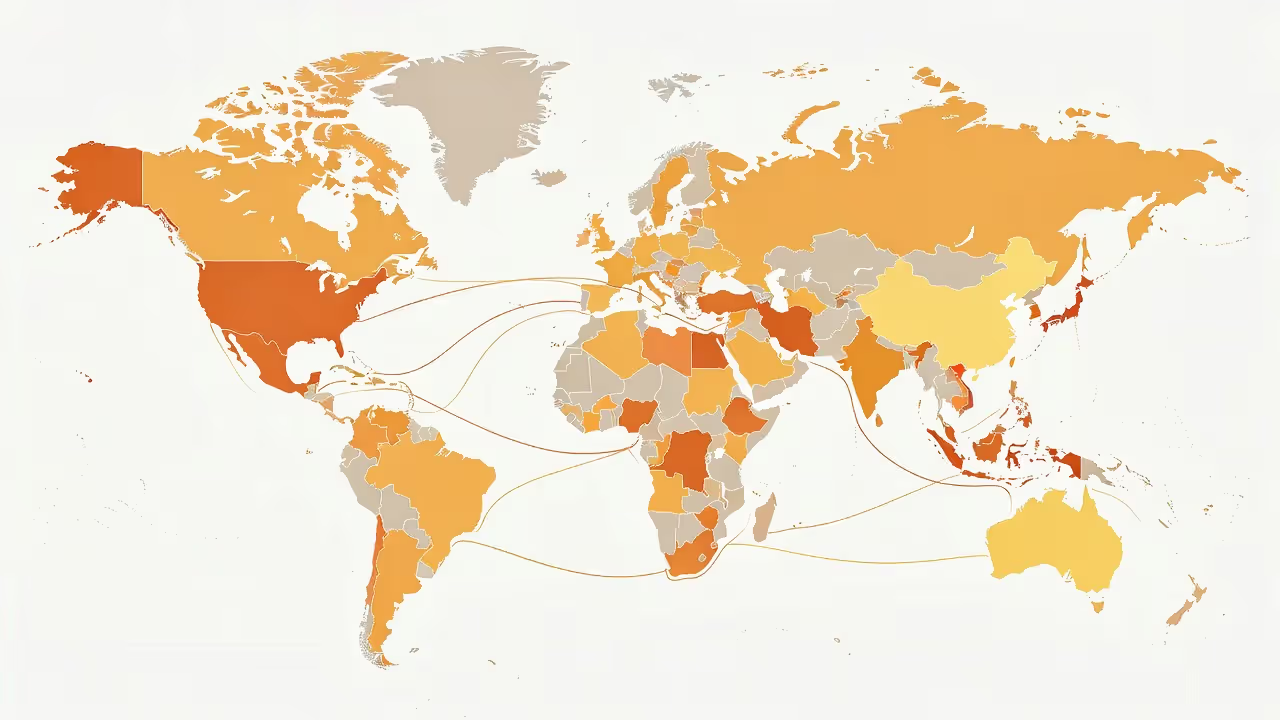
Broadly speaking, most families should expect 2 to 5 years from the decision to adopt to the child's arrival home. Some countries — like Colombia or India — have averaged 3 to 5 years in recent cycles. Others move faster.
Author: Rebecca Thornfield;
Source: colorfulpagescoalition.org
The home study alone takes 3 to 6 months in most states. USCIS processing of the I-800A has ranged from 3 to 9 months depending on caseload. Dossier preparation — gathering and authenticating all required documents — typically adds another 3 to 6 months. Then you wait for a match, which is entirely country-controlled.
What causes delays? Document expiration is a big one. Home studies are valid for 18 months. USCIS approvals expire. If your process stalls, you may have to update or redo documents. Country-level policy changes can also freeze programs with no warning.
Who Is Eligible to Adopt Internationally from the US
To adopt internationally as a US citizen, you must meet federal requirements and the specific requirements of the birth country.
At the federal level, you must be a US citizen. If you're married, your spouse must also be named on the adoption. If you're single, you can still adopt — but some countries don't allow it. Age requirements vary: many countries require adoptive parents to be at least 25 or 30, and some cap the age difference between parent and child at 40 to 45 years.
Income requirements aren't set by federal law, but your home study will assess financial stability. You'll need to demonstrate you can support a child without relying on public assistance. A criminal background check — including FBI fingerprints — is mandatory. Certain convictions automatically disqualify applicants under the Adam Walsh Child Protection and Safety Act.
The home study is non-negotiable. No home study, no adoption. Period.
Costs, Fees, and Financial Considerations
International adoption is expensive. The total cost typically runs between $25,000 and $50,000, though some adoptions exceed that. Here's where the money goes.
Agency fees range from $10,000 to $30,000 depending on the provider and the country program. Foreign country fees — court costs, in-country legal fees, orphanage or program fees — add another $5,000 to $15,000. Home study fees run $1,500 to $3,500. USCIS filing fees are a few hundred dollars. And then there's travel: two international trips with lodging and in-country stays can easily add $5,000 to $10,000.
The federal adoption tax credit helps offset some costs. For 2026, the credit is indexed for inflation and applies to qualified adoption expenses up to a set maximum — check the IRS website for the current figure. It's non-refundable but can carry forward up to five years.
Some employers offer adoption assistance benefits. Military families may qualify for additional reimbursement through the DoD adoption reimbursement program, currently up to $2,000 per adoption.

Author: Rebecca Thornfield;
Source: colorfulpagescoalition.org
Don't forget post-adoption costs: state re-adoption proceedings, document translation, and mandatory post-placement reports (typically required by the birth country for 1 to 3 years after the child's arrival).
Common Challenges in International Adoption
The biggest challenge isn't paperwork. It's uncertainty.
Country programs close. Russia suspended adoptions to the US in 2012. Ethiopia closed its program in 2018. Guatemala, once one of the most popular sending countries, shut down in 2008 after widespread fraud. Families mid-process when a country closes face an agonizing situation — sometimes losing years of work and significant money.

Author: Rebecca Thornfield;
Source: colorfulpagescoalition.org
Document complexity trips up a lot of families. Every document in your dossier must typically be notarized, certified by your state, and then authenticated by the US State Department (apostille) before being translated. One error in this chain can delay your whole case.
Wait times are genuinely hard to predict. The State Department publishes country-specific information, but actual timelines often differ from official estimates. Build in buffer. Then add more.
Post-adoption requirements are often underestimated. Many birth countries require adoptive families to submit post-placement reports — sometimes annually for up to three years — documenting the child's adjustment and wellbeing. Missing these reports can jeopardize future adoption programs between the two countries.
And the emotional toll is real. Attachment challenges, grief, and identity questions are common for internationally adopted children. Pre-adoption counseling and post-adoption support services aren't optional extras — they're part of responsible preparation.
FAQ: International Adoption Questions Answered
International adoption is a real path to building a family — but it demands patience, preparation, and a clear-eyed understanding of what you're taking on. The process is long, the costs are significant, and the uncertainties are real. But for many families, the outcome is exactly what they hoped for. Start with solid research, work with an accredited agency, and give yourself more time than you think you'll need. That's the most honest advice anyone can offer.
Related Stories

Read more

Read more




The content on this website is provided for general informational and educational purposes only. It is intended to explain concepts related to parenting, child development, family caregiving, adoption, fostering, and child safety.
All information on this website, including articles, guides, and examples, is presented for general educational purposes. Outcomes may vary depending on individual family circumstances.
This website does not provide professional medical, psychological, or legal advice, and the information presented should not be used as a substitute for consultation with qualified pediatricians, child psychologists, or family counselors.
The website and its authors are not responsible for any errors or omissions, or for any outcomes resulting from decisions made based on the information provided on this website.